1. Change your settings so that email from you has a name, your name, not a blank or some unusual characters, in the from field. (ask a geek or IT person for help if you don't know how).
2. Change your settings so that the bottom of every email includes a signature (often called a sig) that includes your name and your organization.
3. Change your settings so that when you reply to a note, the note you're replying to is included below what you write (this is called quoting).
4. Don't hit reply all. Just don't. Okay, you can, but read this first.
5. You can't recall an email you didn't mean to send. Some software makes you think you can, but you can't. Not reliably.
6. Email lives forever, is easy to spread and can easily show up in discovery for a lawsuit.
7. Please don't ask me to save a tree by not printing your email. It doesn't work, it just annoys the trees.
8. Send yourself some email at a friend's computer. Read it. Are the fonts too big or too small? Does it look like a standard email? If it doesn't look like a standard, does this deviation help you or hurt you? Sometimes, fitting in makes sense, no?
And a bonus tip from Cory Doctorow, who gets more email than you and me combined: When you go on vacation, set up an autoreply that says, "I'm on vacation until x/x/2010. When I get back, I'm going to delete all the email that arrived while I was gone, so if this note is important, please send it to me again after that date."

Monday, April 26, 2010
Thursday, April 22, 2010
Our Public Library Lifeline is Fraying.........
This is long for a blog post - but the article is so good I wanted to post it in its entirety.
Our Public Library Lifeline Is Fraying. We'll Be Sorry When it Snaps
by Art Brodsky, Communications Director, Public Knowledge
Posted: April 11, 2010
http://www.huffingtonpost.com/art-brodsky/our-public-library-lifeli_b_533529.html
This is National Library Week, a time normally reserved for celebrating an institution that plays a vital role in many of our cities, towns and counties. Instead, many libraries, particularly public libraries, are being decimated by budget cuts at a time when library services are needed most.
Libraries, once considered a necessity, are now seen as a luxury. They are low-hanging fruit for budget pluckers, particularly at the state and local levels of government in communities across the country. It's been a slow death by attrition over the past couple of years. First, it was the budget for books and materials because, after all, books and materials aren't people. No matter that books and materials are what makes a library, well, a library. Then came the hours of operation, then the staff, then the closure of branches. No two communities are approaching the situation identically, but in cities from Boston to Indianapolis, the stories are increasingly dire.
In Boston, the trustees voted to close four branches. There was lots of protest, and Mayor Thomas Menino still has to make the final call, but the situation doesn't look good.
The Florida legislature is considering eliminating state aid to libraries entirely, while the New Jersey legislature is only looking a at a 74 percent cut. Indianapolis and surrounding Marion County are also looking at closing six branches and cutting back programs and staff.
In my home community of Montgomery County, Maryland, formerly one of the wealthiest local jurisdictions, the County Council is looking at a budget for fiscal year 2011 of $29 million - down from $40 million just three years ago. This year, it is slated for a 23 percent cut - one of the largest of any agency, on top of cuts in the last fiscal year with percentage decreases larger than all but one county agency. And this is for a county of about one million residents in which 70 percent hold library cards. It's even worse across the river, in Fairfax County, Virgina, where libraries were declared a "discretionary" service while cutting 30 of 54 full-time librarians. Libraries discretionary? That's nuts.
These are only some of the stories. They are being repeated endlessly across the country, perhaps even where you live. Some places put a high value on their libraries. Contrast the $29 million of my county for the $51 million library budget in Seattle, a city of about 600,000. Sure, Seattle needed to cut the library budget, but the fact that they started out much higher than my home says something about their priorities. Sadly, Seattle is the exception, not the rule.
One problem for libraries in some jurisdictions is that they don't fit squarely into any one policymaker's domain, like public safety or a school system. Libraries serve a range of purposes - they help teach children to read, they help students work on projects, they provide meeting space for tutoring, they provide Internet access. They serve students, seniors, immigrants. They provide assistance to the unemployed. Libraries combine education, workforce development, socialization, recreation. But they aren't the school board, or a social services agency, and so generally get buried in the larger budgets.
The cuts come at a time when library use is increasing, for all types of services. The one that hits home the most these days is the crucial access to the Internet. A study by the Information School at the University of Washington found that: "Low-income adults are more likely to rely on the public library as their sole access to computers and the Internet than any other income group. Overall, 44 percent of people living below the federal poverty line used computers and the Internet at their public libraries."
In addition, the study reported: "Americans across all age groups reported they used library computers and Internet access. Teenagers are the most active users. Half of the nation's 14- to 18-year-olds reported that they used a library computer during the past year, typically to do school homework."
Ask any librarian, or read any of the stories about the budget cuts, and one message that stands out loud and clear is that the Internet at libraries is a lifeline for many. Here the unemployed look for jobs, and apply for jobs - many companies these days accept applications online only. Here people learn what many would consider rudimentary skills - how to attach a document to an email, for example. Is this what a library is supposed to do? Yes. The Internet has become an integral part of the library mission.
Internet support for libraries is national policy, going back to the 1996 Telecommunications Act and the amendment from current Senators Olympia Snowe (R-ME) and Jay Rockefeller (D-WVA) as well as former Nebraska senators, the late James Exon and Robert Kerrey. Today, Rep. Ed Markey (D-MA) is trying to update the policy for the 21st century.
But it would be a mistake to say that the Internet replaces libraries. It doesn't. It's an adjunct. More than one budget officer has said that people don't need libraries because they can go online. First, many people can't go online due to their economic circumstances. Second, librarians help to guide research. A simple online search will not always achieve desired results, as anyone who does this well knows. And libraries still have those quaint old things called books, many of which aren't online. The printed medium still has a lot of attraction for many, from the youngest readers whose parents check out armloads of picture books, to the serious readers and researchers who realize there is more to find than what's online.
It would also be a mistake to say that bookstores replace libraries. Nothing against bookstores, but they aren't a public resource. Quite obviously, who have to pay to enjoy the fruits of a bookstore. Libraries are there for everyone.
Politicians are loathe to raise money to pay for libraries. That's the kiss of death to an aroused citizenry that wants services but doesn't want to pay for them or, in some cases doesn't value them at all. Still, it's nice that around the country, people are protesting the cuts to their local libraries. In some cases, library lovers have formed foundations or other organizations to supplement their libraries. These are to be lauded, and supported, but they aren't a substitute for the public commitment that led to public libraries in the first place.
Let's give the last word to someone who has a secret ambition to be a librarian, but whose career went in a different direction. No less an authority than Keith Richards put it best in his forthcoming autobiography: "When you are growing up there are two institutional places that affect you most powerfully: the church, which belongs to God, and the public library, which belongs to you. The public library is a great equaliser."
Our Public Library Lifeline Is Fraying. We'll Be Sorry When it Snaps
by Art Brodsky, Communications Director, Public Knowledge
Posted: April 11, 2010
http://www.huffingtonpost.com/art-brodsky/our-public-library-lifeli_b_533529.html
This is National Library Week, a time normally reserved for celebrating an institution that plays a vital role in many of our cities, towns and counties. Instead, many libraries, particularly public libraries, are being decimated by budget cuts at a time when library services are needed most.
Libraries, once considered a necessity, are now seen as a luxury. They are low-hanging fruit for budget pluckers, particularly at the state and local levels of government in communities across the country. It's been a slow death by attrition over the past couple of years. First, it was the budget for books and materials because, after all, books and materials aren't people. No matter that books and materials are what makes a library, well, a library. Then came the hours of operation, then the staff, then the closure of branches. No two communities are approaching the situation identically, but in cities from Boston to Indianapolis, the stories are increasingly dire.
In Boston, the trustees voted to close four branches. There was lots of protest, and Mayor Thomas Menino still has to make the final call, but the situation doesn't look good.
The Florida legislature is considering eliminating state aid to libraries entirely, while the New Jersey legislature is only looking a at a 74 percent cut. Indianapolis and surrounding Marion County are also looking at closing six branches and cutting back programs and staff.
In my home community of Montgomery County, Maryland, formerly one of the wealthiest local jurisdictions, the County Council is looking at a budget for fiscal year 2011 of $29 million - down from $40 million just three years ago. This year, it is slated for a 23 percent cut - one of the largest of any agency, on top of cuts in the last fiscal year with percentage decreases larger than all but one county agency. And this is for a county of about one million residents in which 70 percent hold library cards. It's even worse across the river, in Fairfax County, Virgina, where libraries were declared a "discretionary" service while cutting 30 of 54 full-time librarians. Libraries discretionary? That's nuts.
These are only some of the stories. They are being repeated endlessly across the country, perhaps even where you live. Some places put a high value on their libraries. Contrast the $29 million of my county for the $51 million library budget in Seattle, a city of about 600,000. Sure, Seattle needed to cut the library budget, but the fact that they started out much higher than my home says something about their priorities. Sadly, Seattle is the exception, not the rule.
One problem for libraries in some jurisdictions is that they don't fit squarely into any one policymaker's domain, like public safety or a school system. Libraries serve a range of purposes - they help teach children to read, they help students work on projects, they provide meeting space for tutoring, they provide Internet access. They serve students, seniors, immigrants. They provide assistance to the unemployed. Libraries combine education, workforce development, socialization, recreation. But they aren't the school board, or a social services agency, and so generally get buried in the larger budgets.
The cuts come at a time when library use is increasing, for all types of services. The one that hits home the most these days is the crucial access to the Internet. A study by the Information School at the University of Washington found that: "Low-income adults are more likely to rely on the public library as their sole access to computers and the Internet than any other income group. Overall, 44 percent of people living below the federal poverty line used computers and the Internet at their public libraries."
In addition, the study reported: "Americans across all age groups reported they used library computers and Internet access. Teenagers are the most active users. Half of the nation's 14- to 18-year-olds reported that they used a library computer during the past year, typically to do school homework."
Ask any librarian, or read any of the stories about the budget cuts, and one message that stands out loud and clear is that the Internet at libraries is a lifeline for many. Here the unemployed look for jobs, and apply for jobs - many companies these days accept applications online only. Here people learn what many would consider rudimentary skills - how to attach a document to an email, for example. Is this what a library is supposed to do? Yes. The Internet has become an integral part of the library mission.
Internet support for libraries is national policy, going back to the 1996 Telecommunications Act and the amendment from current Senators Olympia Snowe (R-ME) and Jay Rockefeller (D-WVA) as well as former Nebraska senators, the late James Exon and Robert Kerrey. Today, Rep. Ed Markey (D-MA) is trying to update the policy for the 21st century.
But it would be a mistake to say that the Internet replaces libraries. It doesn't. It's an adjunct. More than one budget officer has said that people don't need libraries because they can go online. First, many people can't go online due to their economic circumstances. Second, librarians help to guide research. A simple online search will not always achieve desired results, as anyone who does this well knows. And libraries still have those quaint old things called books, many of which aren't online. The printed medium still has a lot of attraction for many, from the youngest readers whose parents check out armloads of picture books, to the serious readers and researchers who realize there is more to find than what's online.
It would also be a mistake to say that bookstores replace libraries. Nothing against bookstores, but they aren't a public resource. Quite obviously, who have to pay to enjoy the fruits of a bookstore. Libraries are there for everyone.
Politicians are loathe to raise money to pay for libraries. That's the kiss of death to an aroused citizenry that wants services but doesn't want to pay for them or, in some cases doesn't value them at all. Still, it's nice that around the country, people are protesting the cuts to their local libraries. In some cases, library lovers have formed foundations or other organizations to supplement their libraries. These are to be lauded, and supported, but they aren't a substitute for the public commitment that led to public libraries in the first place.
Let's give the last word to someone who has a secret ambition to be a librarian, but whose career went in a different direction. No less an authority than Keith Richards put it best in his forthcoming autobiography: "When you are growing up there are two institutional places that affect you most powerfully: the church, which belongs to God, and the public library, which belongs to you. The public library is a great equaliser."

Sunday, April 18, 2010
Dulcinea Media - a significant find at the TLA Conference!
A significant highlight of my experiences at this year's TLA Conference was meeting Mark Moran, President & CEO of Dulcinea Media, and seeing the online products his company provides without fee. Check out any or all of the following and see if you're not impressed:
http://www.dulcineamedia.com/
http://www.findingdulcinea.com/ & www.encontrandodulcinea.com/ - Be sure to review the index at the bottom of each page!
http://www.sweetsearch.com/
http://www.findingeducation.com/
According to their website, their mission is "to bring users the best information on the Web for any topic, employing human insight and methodical review." Information at www.findingDulcinea.com/employees.html, shows that they employee a team with appropriate expertise to tackle the challenge of meeting that mission.
For more information, read "8 Ways that Public Librarians Can Use Dulcinea Media to Serve Patrons" at http://blog,findingdulcinea.com/2010/04/8-ways-that-public-libraries-can-use-dulcinea-media-to-serve-their-patrons.html and "8 Ways a Week: Using Dulcinea Media in the Classroom" at http://blog.findingdulcinea.com/2010/04/8-ways-a-week-using-dulcinea-media-in-the-classroom.html.
http://www.dulcineamedia.com/
http://www.findingdulcinea.com/ & www.encontrandodulcinea.com/ - Be sure to review the index at the bottom of each page!
http://www.sweetsearch.com/
http://www.findingeducation.com/
According to their website, their mission is "to bring users the best information on the Web for any topic, employing human insight and methodical review." Information at www.findingDulcinea.com/employees.html, shows that they employee a team with appropriate expertise to tackle the challenge of meeting that mission.
For more information, read "8 Ways that Public Librarians Can Use Dulcinea Media to Serve Patrons" at http://blog,findingdulcinea.com/2010/04/8-ways-that-public-libraries-can-use-dulcinea-media-to-serve-their-patrons.html and "8 Ways a Week: Using Dulcinea Media in the Classroom" at http://blog.findingdulcinea.com/2010/04/8-ways-a-week-using-dulcinea-media-in-the-classroom.html.
Thursday, April 08, 2010
Hmmmm..Makes one think.........
As a follow-up to last night's Find a Job in Federal Libraries chat (please see the Wimba classroom off the SLIS Village homepage for the archive and the Career forum in the Village for the panelists' notes), please consider joining the Careers in Federal Libraries Google Group. The group's founder, Nancy Faget (also one of last night's panelists) describes the group below:
Students and job seekers may be interested in federal librarianship as a career choice because:
1. The average annual salary of a federal librarian is approximately $84,000
2. There are school, academic, medical, law, public, and special libraries in federal government
3. The Feds are hiring, even in this tough job market
An online group was set up to allow those interested in this career choice to continue the conversation with federal librarians. Educational presentations, resume reviews, and mentors are available on the Careers in Federal Libraries Google group. You may want to join and receive job announcements and career advice from federal librarians in ALA and SLA.
Students and job seekers may be interested in federal librarianship as a career choice because:
1. The average annual salary of a federal librarian is approximately $84,000
2. There are school, academic, medical, law, public, and special libraries in federal government
3. The Feds are hiring, even in this tough job market
An online group was set up to allow those interested in this career choice to continue the conversation with federal librarians. Educational presentations, resume reviews, and mentors are available on the Careers in Federal Libraries Google group. You may want to join and receive job announcements and career advice from federal librarians in ALA and SLA.
How Libraries Stack Up
Mentioned before (I think) but worth repeating..........
How Libraries Stack Up: 2010
This new report examines the economic, social and cultural impact of libraries in the United States. As the current economic environment is impacting library budgets and library usage is increasing, particular attention is paid to the role that libraries play in providing assistance to job-seekers and support for small businesses. Information includes statistics on:
•Americans receiving job-seeking help and career assistance at public libraries
•Libraries as a resource for small businesses
•The prevalence and scope of library activity in the United States
•Libraries as providers of free services to the community such as Wi-Fi access, technology training and meeting rooms
•Comparisons of library activities to various retail and entertainment businesses
How Libraries Stack Up: 2010
This new report examines the economic, social and cultural impact of libraries in the United States. As the current economic environment is impacting library budgets and library usage is increasing, particular attention is paid to the role that libraries play in providing assistance to job-seekers and support for small businesses. Information includes statistics on:
•Americans receiving job-seeking help and career assistance at public libraries
•Libraries as a resource for small businesses
•The prevalence and scope of library activity in the United States
•Libraries as providers of free services to the community such as Wi-Fi access, technology training and meeting rooms
•Comparisons of library activities to various retail and entertainment businesses
Recently updated at NTRLS.org
New things to see at NTRLS.org:
- Were you at the System Assembly in Denton last January? Visit the photos page and see our photographs. Look for 'photos' under the Resources menu.
- Our Librarian Live partners post new podcasts several times a month. Meet Kim Doner, the artist for the 2010 Texas Reading Club and learn about a wireless network device and a free web content filter that might be useful in your library. Recent Librarian Live podcasts are listed in the box on the right-hand-side of our web page. Click 'all podcasts' to get to the archive of the entire podcast series.
- TWDL - Texas Workskills Development in Libraries - is the program we developed through the SYNG grant to provide resource for libraries to help job seekers. See NTRLS.org for more information, or go straight to the TWDL website at http://www.twdl.org/.
- We're gearing up for this summer's Close the Book on Hunger campaign, to fight hunger and illiteracy in North Texas. See the project website at http://www.closethebookonhunger.org/ .
- A few of our libraries recently sent us updates on their websites and automation systems. Do we have correct information about your library? Look for 'Library Websites and OPACS' and ‘Automation Systems’ under the Members menu.
- The scrolling box on the left side of our website has links to the the latest items in the NTRLS Blog , Adam Wright's blog Notes of a Binge Thinker, and the Libraries for Literacy website. Check these blogs often so you won't miss anything.
- Our Sample Library Policies page now includes a sample policy for Social Software, thanks to Denton Public Library. Look for "Policies-Examples" under the "Resources" menu.
- At the March regional meetings, we received some questions about the differences between regional meetings and system assemblies. The Meeting Details page now has a brief description of these two kinds of meetings. Click 'Meeting Details' from the main Meetings Portal page, http://www.ntrls.org/meetings/.
- The dates for the next five regional conferences are on a handy flyer you can get to from our home page. The dates are also posted on the SIGS page - look for 'SIGS and Regional Conferences' under the Continuing Education menu. Or check each conference's website: LibraryPresentationsNetwork.com (for LP3), LibraryYouthServicesNetwork.com (for CYC), LibrarySupportersNetwork.com (for the Supporters Conference) and LibraryTechNetwork.com (for TechNet). These links are all on our home page at the bottom right.
- Remember to check the CE Portal often for upcoming workshops and conferences. Registration is now open for the TechNet conference in May, as well as workshops on Accessibility, Budgeting, Long Range Planning, and more!
Thanks for visiting North Texas Library Partners at http://www.ntrls.org/ !
Monday, April 05, 2010
Micro-Volunteering
>From a report commissioned by the James Irvine Foundation called, Convergence:
How Five Trends Will Reshape the Social Sector http://www.lapiana.org/downloads/Convergence_Report_2009.pdf
Options for volunteering are increasing along with the development of new technologies and online platforms for connecting interested individuals with causes, actions and communities of like-minded activists. Virtual volunteering, where tasks are undertaken at least partly online, is increasing in popularity, allowing individuals to find opportunities that are personally meaningful and a good fit for their skills, regardless of geography.
The even newer concept of micro-volunteering — where volunteers help out in small, convenient ways that do not require a long-term commitment to an organization or cause — is also growing. The economic downturn is likely to bolster this trend, as online engagement offers an opportunity to give back in one’s spare time, while reducing transportation costs and travel time.
How Five Trends Will Reshape the Social Sector http://www.lapiana.org/downloads/Convergence_Report_2009.pdf
Options for volunteering are increasing along with the development of new technologies and online platforms for connecting interested individuals with causes, actions and communities of like-minded activists. Virtual volunteering, where tasks are undertaken at least partly online, is increasing in popularity, allowing individuals to find opportunities that are personally meaningful and a good fit for their skills, regardless of geography.
The even newer concept of micro-volunteering — where volunteers help out in small, convenient ways that do not require a long-term commitment to an organization or cause — is also growing. The economic downturn is likely to bolster this trend, as online engagement offers an opportunity to give back in one’s spare time, while reducing transportation costs and travel time.
Thursday, April 01, 2010
A Book Free Future - we keep hearing this!
Librarians envision a book-free future
PORTLAND, Ore., April 1, 2010 (NW Newswire) -- Librarians in your town or city will soon be arguing for the elimination of books from your public library. In response to a call for action issued at a major librarians' conference in this city on Wednesday of last week, over 750 leaders in the field met in the Grand Portland Ballroom of the Oregon Convention Center to found a new advocacy group, the Redeployment of Library Resources for Renewal Round Table, or RDLRRRT, which will be affiliated with a major professional organization.
"As the interest in, and need for, literacy declines in the era of networked information sharing, public libraries must realign their priorities to better match the interests of their communities," said Lucia Ashton, a Seattle-area public library administrator tapped as first chair of RDLRRRT. "Thousands of shelves of books idly occupy millions of square feet of library space across the country, space that can be repurposed for greatly expanded public computing, coffee service, gaming, and suites of study and meeting rooms."
"Today's library patrons want what I call the Three C's -- computers, coffee, and community," noted Edgar Ravenswood, RDLRRRT member and public-relations coordinator. "The Three C's require space -- space now inefficiently occupied by books, few of which circulate at levels high enough to justify their continued existence," he asserted. "The cost/benefit analysis simply no longer supports books, whereas the Three C's show large, measurable social benefits for the space expended on them."
RDLRRRT member-at-large Art Bucklaw concurs. "At my library, entire mornings can transpire with not a single member of the public seen in some ranges of the bookstacks. Imagine that space devoted to computers, gaming, or conferencing, or simply to a good cup of coffee! We do our taxpayers no service by tying up expensive square footage with a medium no one uses or cares about," he observed. "Even Steve Jobs said 'people don't read anymore.' "
Ashton emphasized that there are now excellent alternative channels -- reading devices such as Kindle, Nook, and iPad, and inexpensive book lending services such as BookSwim -- available to the relatively few, representing an older and declining demographic, who still indulge in longform reading. "They can get more of what they want faster and cheaper through those channels, frankly, than through the public library," she remarked. "The public library has never been 'free.' Tax money is involved. Why not deploy that resource in the way our customers clearly want? Reading is moving in the direction of Twitter-size bites, and 'information' is whatever our users want it to be. These are just the kinds of activities we can support and promote with our computers, wifi, space, and tech savvy."
RDLRRRT's initial goal is the launching of several EPLOTs -- Experimental Prototype Libraries of Tomorrow -- around the United States. "We want to get a few libraries interested in the concept of completely clearing their facilities of books," Ashton stated. "RDLRRRT will assist the libraries in using the federal grants process to obtain funding for computers, wifi, game consoles, and coffee bars to fill the space once wasted on books."
"We are confident that the EPLOTs will see usage levels never before encountered in library service," Ravenswood asserted. "The EPLOTs will stand as proof-of-concept projects, and will serve notice as to just how relevant and -- may I say it? -- hip public libraries can be. Once they are book-free, the sky will be the limit."
I find this article interesting - while I agree people are reading less and listening more - MAYBE - the bookstores are awfully full when I go in with people reading and buying books - and many look under the age of 40 and quite trendy..............We certainly have more reference books than are necessary, and I firmly believe in weeding materials, "if in doubt, throw it out!" libraries as a generalization are not responsive to community needs - and some - not just ancient people - want books.......
PORTLAND, Ore., April 1, 2010 (NW Newswire) -- Librarians in your town or city will soon be arguing for the elimination of books from your public library. In response to a call for action issued at a major librarians' conference in this city on Wednesday of last week, over 750 leaders in the field met in the Grand Portland Ballroom of the Oregon Convention Center to found a new advocacy group, the Redeployment of Library Resources for Renewal Round Table, or RDLRRRT, which will be affiliated with a major professional organization.
"As the interest in, and need for, literacy declines in the era of networked information sharing, public libraries must realign their priorities to better match the interests of their communities," said Lucia Ashton, a Seattle-area public library administrator tapped as first chair of RDLRRRT. "Thousands of shelves of books idly occupy millions of square feet of library space across the country, space that can be repurposed for greatly expanded public computing, coffee service, gaming, and suites of study and meeting rooms."
"Today's library patrons want what I call the Three C's -- computers, coffee, and community," noted Edgar Ravenswood, RDLRRRT member and public-relations coordinator. "The Three C's require space -- space now inefficiently occupied by books, few of which circulate at levels high enough to justify their continued existence," he asserted. "The cost/benefit analysis simply no longer supports books, whereas the Three C's show large, measurable social benefits for the space expended on them."
RDLRRRT member-at-large Art Bucklaw concurs. "At my library, entire mornings can transpire with not a single member of the public seen in some ranges of the bookstacks. Imagine that space devoted to computers, gaming, or conferencing, or simply to a good cup of coffee! We do our taxpayers no service by tying up expensive square footage with a medium no one uses or cares about," he observed. "Even Steve Jobs said 'people don't read anymore.' "
Ashton emphasized that there are now excellent alternative channels -- reading devices such as Kindle, Nook, and iPad, and inexpensive book lending services such as BookSwim -- available to the relatively few, representing an older and declining demographic, who still indulge in longform reading. "They can get more of what they want faster and cheaper through those channels, frankly, than through the public library," she remarked. "The public library has never been 'free.' Tax money is involved. Why not deploy that resource in the way our customers clearly want? Reading is moving in the direction of Twitter-size bites, and 'information' is whatever our users want it to be. These are just the kinds of activities we can support and promote with our computers, wifi, space, and tech savvy."
RDLRRRT's initial goal is the launching of several EPLOTs -- Experimental Prototype Libraries of Tomorrow -- around the United States. "We want to get a few libraries interested in the concept of completely clearing their facilities of books," Ashton stated. "RDLRRRT will assist the libraries in using the federal grants process to obtain funding for computers, wifi, game consoles, and coffee bars to fill the space once wasted on books."
"We are confident that the EPLOTs will see usage levels never before encountered in library service," Ravenswood asserted. "The EPLOTs will stand as proof-of-concept projects, and will serve notice as to just how relevant and -- may I say it? -- hip public libraries can be. Once they are book-free, the sky will be the limit."
I find this article interesting - while I agree people are reading less and listening more - MAYBE - the bookstores are awfully full when I go in with people reading and buying books - and many look under the age of 40 and quite trendy..............We certainly have more reference books than are necessary, and I firmly believe in weeding materials, "if in doubt, throw it out!" libraries as a generalization are not responsive to community needs - and some - not just ancient people - want books.......
Telecommuting by the Numbers#
Telecommuting by the Numbers#: "Telecommuting by the Numbers
What the U.S. could save if more people worked from home
By Max Chafkin | Apr 1, 2010"
Great article about the impact if people starting working from home..........I like the idea of telecommuting but also feel a bit of dread as it seems everything is moving to non-people contact - stay in your home - work, IM, watch youtube, and keep the DVR going.......
I really like this fact though - as someone who oftens gets caught in traffic........100 hours per person not spent commuting
What the U.S. could save if more people worked from home
By Max Chafkin | Apr 1, 2010"
Great article about the impact if people starting working from home..........I like the idea of telecommuting but also feel a bit of dread as it seems everything is moving to non-people contact - stay in your home - work, IM, watch youtube, and keep the DVR going.......
I really like this fact though - as someone who oftens gets caught in traffic........100 hours per person not spent commuting
Tuesday, March 30, 2010
Is Twitter Relevant?
Date: March 29, 2010 10:22:08 PM CDT
Subject: Boom! Tweets & Maps Swarm to Pinpoint a Mysterious Explosion
Source: ReadWriteWeb
Author: Marshall Kirkpatrick
What would you do if you heard a giant boom and you didn't know where it came from? If you're like thousands of people in Portland, Oregon, you might hit Twitter and Google Maps to participate in the city-wide exploration of a slightly frightening mystery. Last night at about 8 p.m., people in a big part of the city felt their windows shake and no one could tell them what caused it.
Was it a sonic boom? An angry deity? Even the mayor himself tweeted this morning that he was looking into the sound. In the meantime, thousands of people were using the hashtag #pdxboom and adding themselves to a hastily configured Google Map showing where they lived and how loud the boom had been there. In just a few hours, a pattern emerged, with reports clustering around one city park. This morning the police found a detonated pipe bomb there and cited the Google Map in their announcement.
Sponsor
Pausing the Stream
Reid Beels is a designer, geo-developer and one of the community organizers of Portland's forthcoming conference Open Source Bridge ("The conference for open source citizens").
Beels says he was sitting in a restaurant in southeast Portland when he heard the boom, and saw tweets streaming in about it within minutes. He searched Twitter for "boom" and "explosion," limiting the results by location. Within five minutes, he says, a hashtag had emerged: #pdxboom.
What was the #pdxboom, people wanted to know? Some people said it sounded like thunder. Lots of people said it sounded like an empty trash Dumpster crashing on the ground. They mentioned their locations in their Tweets and Beels quickly grew frustrated that all this data was just streaming into the ether, lost from analysis.
So he threw up a Google Map with instructions to put a pin in your location and describe how the boom sounded to you.
Within an hour 100 people had placed pins on the map. Beels and developer Audrey Eschright came up with a color coded system to describe the intensity of the sound, and began retroactively coloring in pins based on any comments people left.
Then they found out that Google Maps will only display the 200 most recent pins placed in a public map. Beels' friend Aaron Parecki wrote a script to download the map's data every fifteen minutes. That came in handy when a few hours later someone vandalized the map by dragging a large number of markers outside the town. It was trivial to roll back to the last valid data.
The local TV news and the newspaper ran stories about the boom, and pointed their audiences at the Google Map. Thousands of people visited it, and just under 1,000 added a pin marking where they where and how loud the boom had sounded to them.
It became clear that the boom originated near the Sellwood Bridge; a big cluster of red markers surrounded the area, especially to the east. Thousands of people are still streaming in to look at the map; at the end of the day it's now approaching 70,000 views, even if the mystery, if not the crime, is solved.
Some people thought it was a precursor Earthquake Boom. (I woke up convinced my basement bedroom was underground in an earthquake.) But the Portland police went to a park in the area most filled with red flags on the map and found a large, detonated, pipe bomb. A Portland police spokesperson said the maps and tweets were very helpful.
A topographic view of the map made some inclined to believe that cliffs across the river and low-hanging clouds combined to make the sound travel as far across the city and in the direction that it did.
That Was a Practice Run
Beels says two big lessons came out of the experience for him. First, the tools they used were easy and fast, but they were also quite limited. Google Maps in particular was capable of multi-user collaboration but did poorly when it came to displaying a large amount of data. As Eschright wrote after the action, "It's not the best platform for a couple hundred people, many without prior experience editing maps, to be using all at once."
Inspired by campaigns like CrisisCampPDX and the CrisisWiki, Beels says the community is interested in setting up an installation of open-source, crisis support software Ushahidi on standby in case a real crisis has to be dealt with.
Beels says he's inspired not just by what was done in this situation, but by what it revealed about the future. "The community of people who will search for things online and go out of their way to try to figure out what's going on," he says, "is larger than you might think."
Subject: Boom! Tweets & Maps Swarm to Pinpoint a Mysterious Explosion
Source: ReadWriteWeb
Author: Marshall Kirkpatrick
What would you do if you heard a giant boom and you didn't know where it came from? If you're like thousands of people in Portland, Oregon, you might hit Twitter and Google Maps to participate in the city-wide exploration of a slightly frightening mystery. Last night at about 8 p.m., people in a big part of the city felt their windows shake and no one could tell them what caused it.
Was it a sonic boom? An angry deity? Even the mayor himself tweeted this morning that he was looking into the sound. In the meantime, thousands of people were using the hashtag #pdxboom and adding themselves to a hastily configured Google Map showing where they lived and how loud the boom had been there. In just a few hours, a pattern emerged, with reports clustering around one city park. This morning the police found a detonated pipe bomb there and cited the Google Map in their announcement.
Sponsor
Pausing the Stream
Reid Beels is a designer, geo-developer and one of the community organizers of Portland's forthcoming conference Open Source Bridge ("The conference for open source citizens").
Beels says he was sitting in a restaurant in southeast Portland when he heard the boom, and saw tweets streaming in about it within minutes. He searched Twitter for "boom" and "explosion," limiting the results by location. Within five minutes, he says, a hashtag had emerged: #pdxboom.
What was the #pdxboom, people wanted to know? Some people said it sounded like thunder. Lots of people said it sounded like an empty trash Dumpster crashing on the ground. They mentioned their locations in their Tweets and Beels quickly grew frustrated that all this data was just streaming into the ether, lost from analysis.
So he threw up a Google Map with instructions to put a pin in your location and describe how the boom sounded to you.
Within an hour 100 people had placed pins on the map. Beels and developer Audrey Eschright came up with a color coded system to describe the intensity of the sound, and began retroactively coloring in pins based on any comments people left.
Then they found out that Google Maps will only display the 200 most recent pins placed in a public map. Beels' friend Aaron Parecki wrote a script to download the map's data every fifteen minutes. That came in handy when a few hours later someone vandalized the map by dragging a large number of markers outside the town. It was trivial to roll back to the last valid data.
The local TV news and the newspaper ran stories about the boom, and pointed their audiences at the Google Map. Thousands of people visited it, and just under 1,000 added a pin marking where they where and how loud the boom had sounded to them.
It became clear that the boom originated near the Sellwood Bridge; a big cluster of red markers surrounded the area, especially to the east. Thousands of people are still streaming in to look at the map; at the end of the day it's now approaching 70,000 views, even if the mystery, if not the crime, is solved.
Some people thought it was a precursor Earthquake Boom. (I woke up convinced my basement bedroom was underground in an earthquake.) But the Portland police went to a park in the area most filled with red flags on the map and found a large, detonated, pipe bomb. A Portland police spokesperson said the maps and tweets were very helpful.
A topographic view of the map made some inclined to believe that cliffs across the river and low-hanging clouds combined to make the sound travel as far across the city and in the direction that it did.
That Was a Practice Run
Beels says two big lessons came out of the experience for him. First, the tools they used were easy and fast, but they were also quite limited. Google Maps in particular was capable of multi-user collaboration but did poorly when it came to displaying a large amount of data. As Eschright wrote after the action, "It's not the best platform for a couple hundred people, many without prior experience editing maps, to be using all at once."
Inspired by campaigns like CrisisCampPDX and the CrisisWiki, Beels says the community is interested in setting up an installation of open-source, crisis support software Ushahidi on standby in case a real crisis has to be dealt with.
Beels says he's inspired not just by what was done in this situation, but by what it revealed about the future. "The community of people who will search for things online and go out of their way to try to figure out what's going on," he says, "is larger than you might think."
Friday, March 26, 2010
PLA Day 2 - my feet hurt!
Okay, I am ready to eat crow - the first session I wanted to attend was too full - so I guess there ARE alot of people here. I have to say I have attended really good sessions today.
The first one was "Oh, I Wish I'd Said.....(aka: Dealing With Difficult People by Pam Parr and Gail Johnson - these ladies are funny! They also suggested two sentences can help handle almost any situation.......and they are: 1. I am sorry that happened and 2. I can take care of that for you. Neither of these mean you or the library is at fault - but that you are sorry about the situation and will take care of it - even if that means calling the police. Many people feel upset if they think they weren't treated "fairly". But fairness is in the eye of the beholder.........so ask them what they think is fair.
Next I have attended an update on Paco Underhill's Envirosell and their library study "Why We Borrow" - for those that know me you know I often refer to his book Why We Buy. Very insightful information - I plan to incorporate more of this into the Image Audits that I do with libraries. One comment made is "retail" is not a four letter word! Look at how your users use the library space and respond accordingly.
A side note: I am becoming quite the seasoned transit rider - it is so nice - we need this system in North Texas. The rail police even talked to me this morning - and thankfully I had bought the right ticket! : )
The first one was "Oh, I Wish I'd Said.....(aka: Dealing With Difficult People by Pam Parr and Gail Johnson - these ladies are funny! They also suggested two sentences can help handle almost any situation.......and they are: 1. I am sorry that happened and 2. I can take care of that for you. Neither of these mean you or the library is at fault - but that you are sorry about the situation and will take care of it - even if that means calling the police. Many people feel upset if they think they weren't treated "fairly". But fairness is in the eye of the beholder.........so ask them what they think is fair.
Next I have attended an update on Paco Underhill's Envirosell and their library study "Why We Borrow" - for those that know me you know I often refer to his book Why We Buy. Very insightful information - I plan to incorporate more of this into the Image Audits that I do with libraries. One comment made is "retail" is not a four letter word! Look at how your users use the library space and respond accordingly.
A side note: I am becoming quite the seasoned transit rider - it is so nice - we need this system in North Texas. The rail police even talked to me this morning - and thankfully I had bought the right ticket! : )
Thursday, March 25, 2010
I am at PLA!
I arrived today at PLA and hit the ground running.............and I am proud to say that I have the light rail connections figured out.
I attended a couple sessions and visited several exhibitors - and yes, grabbed some freebies. There seems to be a common thread running tnrough the sessions - survival in tough times. It may also be my imagination but it seems like there are fewer people here - an example of a tough time in library world? One thing I have definitely taken away from the sessions is that it takes the dedication of all of us to keep our libraries relevant and growing. Speakers are building morale and being supportive - truly cheering on all of the hard working staff.
Also discussion of a revolution is prevalent - to dewey or not, support your supporters and tell non-supporters to take a hike, grow civic activities together and so on............
Oh yea, the really important stuff - went to voodoo donuts - the best one I had was the dirty rotten bastard - a concoction of chocolate, peanut butter and I am not even sure what all - yum! Popular local joint as we waited in line for 30 minutes - there is ALWAYS a line apparently.
Hopefully will get more rest and will have a very pruductive day tomorrow.....
No problems.............they seem to say that phrase alot up here.............
I attended a couple sessions and visited several exhibitors - and yes, grabbed some freebies. There seems to be a common thread running tnrough the sessions - survival in tough times. It may also be my imagination but it seems like there are fewer people here - an example of a tough time in library world? One thing I have definitely taken away from the sessions is that it takes the dedication of all of us to keep our libraries relevant and growing. Speakers are building morale and being supportive - truly cheering on all of the hard working staff.
Also discussion of a revolution is prevalent - to dewey or not, support your supporters and tell non-supporters to take a hike, grow civic activities together and so on............
Oh yea, the really important stuff - went to voodoo donuts - the best one I had was the dirty rotten bastard - a concoction of chocolate, peanut butter and I am not even sure what all - yum! Popular local joint as we waited in line for 30 minutes - there is ALWAYS a line apparently.
Hopefully will get more rest and will have a very pruductive day tomorrow.....
No problems.............they seem to say that phrase alot up here.............
New Program
TWDL
The Texas Workskills Development in Libraries, better known as TWDL (pronounced Twiddle), has begun. It is a cooperative effort by North Texas Regional Library System, Big Country Library System, Houston Area Library System, Northeast Texas Library System, Texas Trans-Pecos Library System, and the West Texas Library System. It is made possible by a grant from the Texas State Library and Archives Commission.
TWDL was created to help Texas residents obtain information and learn better ways to look for a job as well as providing ways to improve their job skills. The project supports Texas library staff, management and volunteers in gathering job training resources that can be easily accessed and offered to all Texans.
Carolyn Davidson Brewer, Assistant Director at NTRLS, has developed and scheduled a series of more than 52 free workshops thoughout North Texas to provide information about resume writing, interviewing strategies, job searching and much more.
One of the most exciting developments of TWDL is the web site www.twdl.org. In addition to information, another highlight online is the links to self-paced tutorials, lists of agencies offering free training by region and much more. Because each library system offers different programs all over the state, go to www.twdl.org to see what is available in your area. The TWDL web site allows all to access the valuable information 24/7.
At NTRLS we are seeing tremendous success early in this project. Workshops are full and even when a workshop has ended, people stay to talk to Carolyn to try to get additional personalized information. She is often on location an hour after the workshops end.
If a librarian needs help getting information about TWDL to their communities, promotional materials have been developed that are easily personalized for every participating library to use in their community. The materials include bookmarks, flyers, and posters.
The need for this service is great and to quote Adam Wright, Executive Director at NTRLS, “The public library has always been known as a resource for providing quality information and now during these economically stressful times, we wanted to provide work skill information that will help people become employed or improve their skills.”
If you would like more information about TWDL, please call Aera Yoon at the North Texas Regional Library System at 817.377.4440.
The Texas Workskills Development in Libraries, better known as TWDL (pronounced Twiddle), has begun. It is a cooperative effort by North Texas Regional Library System, Big Country Library System, Houston Area Library System, Northeast Texas Library System, Texas Trans-Pecos Library System, and the West Texas Library System. It is made possible by a grant from the Texas State Library and Archives Commission.
TWDL was created to help Texas residents obtain information and learn better ways to look for a job as well as providing ways to improve their job skills. The project supports Texas library staff, management and volunteers in gathering job training resources that can be easily accessed and offered to all Texans.
Carolyn Davidson Brewer, Assistant Director at NTRLS, has developed and scheduled a series of more than 52 free workshops thoughout North Texas to provide information about resume writing, interviewing strategies, job searching and much more.
One of the most exciting developments of TWDL is the web site www.twdl.org. In addition to information, another highlight online is the links to self-paced tutorials, lists of agencies offering free training by region and much more. Because each library system offers different programs all over the state, go to www.twdl.org to see what is available in your area. The TWDL web site allows all to access the valuable information 24/7.
At NTRLS we are seeing tremendous success early in this project. Workshops are full and even when a workshop has ended, people stay to talk to Carolyn to try to get additional personalized information. She is often on location an hour after the workshops end.
If a librarian needs help getting information about TWDL to their communities, promotional materials have been developed that are easily personalized for every participating library to use in their community. The materials include bookmarks, flyers, and posters.
The need for this service is great and to quote Adam Wright, Executive Director at NTRLS, “The public library has always been known as a resource for providing quality information and now during these economically stressful times, we wanted to provide work skill information that will help people become employed or improve their skills.”
If you would like more information about TWDL, please call Aera Yoon at the North Texas Regional Library System at 817.377.4440.
Wednesday, March 24, 2010
From no library to showcase library!
Almost exactly five years ago, Bedford (TX) residents in favor of a tax rollback won that election by 10 votes. As a result, the Bedford (TX) City Council voted 4-3 to close the Bedford Public Library and several other city services in order to repay 3.5 million dollars collected before the rollback was put in place.
Since then, library supporters have succeeded not only in getting the 17,000 square foot library re-opened but also in urging the City to purchase a former Food Lion building and contracting to have it redesigned as a 40,500 square foot library.
Last night, March 23, 2010, the Bedford (TX) City Council approved the $1.9 million dollar grant for a 244.75 kw solar panel system from the State Energy and Conservation Office for the new Bedford Public Library. The non-roof penetrating solar system will save 343,384 kw annually.
The new library will be a showcase for the community on sustainable and energy efficient green technologies combining geothermal wells, a reflective roof, energy efficient lighting and solar panels. You've come a long way, Bedford!
For more information about the geothermal project, visit http://www.bedfordlibrary.org/assets/PDFs/GeothermalPres.pdf .
For more information about the entire renovation, click on the links in the lower portion of http://www.bedfordlibrary.org/ .
BTW: The floor plan for the new library originated in the focus group made up of Bedford teens.
Since then, library supporters have succeeded not only in getting the 17,000 square foot library re-opened but also in urging the City to purchase a former Food Lion building and contracting to have it redesigned as a 40,500 square foot library.
Last night, March 23, 2010, the Bedford (TX) City Council approved the $1.9 million dollar grant for a 244.75 kw solar panel system from the State Energy and Conservation Office for the new Bedford Public Library. The non-roof penetrating solar system will save 343,384 kw annually.
The new library will be a showcase for the community on sustainable and energy efficient green technologies combining geothermal wells, a reflective roof, energy efficient lighting and solar panels. You've come a long way, Bedford!
For more information about the geothermal project, visit http://www.bedfordlibrary.org/assets/PDFs/GeothermalPres.pdf .
For more information about the entire renovation, click on the links in the lower portion of http://www.bedfordlibrary.org/ .
BTW: The floor plan for the new library originated in the focus group made up of Bedford teens.
Visit NTRLS.org before March is over!
Be sure to check out the NTRLS website before the end of the month so you don't miss the March news.
Libraries other than public libraries can now become members of NTRLS. It's free and easy for academic, school and special libraries to join the community that determines NTRLS programs and services. See http://www.ntrls.org/membership/ for membership criteria and membership application forms – or look for 'Criteria for Membership' under the 'Members' menu.
Award nominations are open through April 12. See http://www.ntrls.org/awards/ or look for 'Award Nomination Form' under the Resources menu. Awards will be presented at the Awards Luncheon following the System Assembly on May 27.
There's about a week left for this month's theme – Comparing Office Software Suites, in which we compare Microsoft Office, OpenOffice and GoogleDocs in our theme article and podcast. You should also check the column from Adam Wright and Adam Beatty's story about keeping Internet Explorer 8 in good working order.
We're putting together the web theme for April. Come back to NTRLS.org after April 1 to see it!
Libraries other than public libraries can now become members of NTRLS. It's free and easy for academic, school and special libraries to join the community that determines NTRLS programs and services. See http://www.ntrls.org/membership/ for membership criteria and membership application forms – or look for 'Criteria for Membership' under the 'Members' menu.
Award nominations are open through April 12. See http://www.ntrls.org/awards/ or look for 'Award Nomination Form' under the Resources menu. Awards will be presented at the Awards Luncheon following the System Assembly on May 27.
There's about a week left for this month's theme – Comparing Office Software Suites, in which we compare Microsoft Office, OpenOffice and GoogleDocs in our theme article and podcast. You should also check the column from Adam Wright and Adam Beatty's story about keeping Internet Explorer 8 in good working order.
We're putting together the web theme for April. Come back to NTRLS.org after April 1 to see it!
Tuesday, March 23, 2010
National Call Center for Homeless Veterans
Librarians may come in contact with homeless Veterans, Veterans at risk of homelessness and/or families and friends of Veterans who may be homeless or at risk. Below is information to share:
While the Department of Veterans Affairs (VA) has not yet made a formal announcement about it, the National Homeless Veteran Call Center and Homeless Veteran Chatline Service are up and running and the telephone number and related information are on the VA website.
To access it, log onto www.va.gov, scroll down to the right hand corner to Special Programs. Click on Homeless Veterans. Once on that page, click the third bullet (left hand side) – National Call Center for Homeless Veterans—under Useful Links.
While the Department of Veterans Affairs (VA) has not yet made a formal announcement about it, the National Homeless Veteran Call Center and Homeless Veteran Chatline Service are up and running and the telephone number and related information are on the VA website.
To access it, log onto www.va.gov, scroll down to the right hand corner to Special Programs. Click on Homeless Veterans. Once on that page, click the third bullet (left hand side) – National Call Center for Homeless Veterans—under Useful Links.
Friday, March 19, 2010
Finding Jobs | Texas Workskills Development in Libraries
Finding Jobs | Texas Workskills Development in Libraries: "If you use Twitter, you can sign up for job notifications with TweetmyJobs.com.
The TweetMyJOBS service lets job seekers receive instant notifications on their phone when new jobs are posted online via the popular micro-messaging service Twitter. The company aggregates the Twitter-based job postings from over 7000 companies and maintains over 8250 specific job channels within those companies, all of which are searchable via their website."
How TweetMyJOBS Works
The TweetMyJOBS service lets job seekers receive instant notifications on their phone when new jobs are posted online via the popular micro-messaging service Twitter. The company aggregates the Twitter-based job postings from over 7000 companies and maintains over 8250 specific job channels within those companies, all of which are searchable via their website.
However, it's the job matching service that makes TweetMyJOBS worth using for those in need of work. Instead of having to follow potentially hundreds of Twitter accounts belonging to companies, the service will match a Twitter user's interests with the available jobs posted to Twitter. Users can also specify a particular geographic region where they prefer to work. They can even use the service to post their resume to Twitter. When a job seeker and a job listing match up, the user is alerted via a text message sent to their phone via Twitter.
For job posters, there are fees involved for adding listings just like there are with any other job board. At present, it costs $4000 to list 500 jobs and $8000 for unlimited job postings. Single posts are $1.99. In return, companies are able to directly connect with qualified candidates while also tracking the clicks on the jobs they list.
Sears Holdings: 7000 Jobs Now, Hundreds of Thousands to Come
At launch time, Sears Holdings has posted 7000 jobs to TweetMyJOBS. The lineup includes everything from cashiers to vice presidents, a company representative tells us. And this is just the beginning. Over the course of the year, the company will continue adding all their available jobs to the service. Since, as noted above, the company posts hundreds of thousands of jobs per year, they will soon have thousands more to post to TweetMyJOBS.
In today's tough, competitive hiring market, a service like this can give motivated job seekers an edge. Since it allows for instant notification when a job is made available online, users of TweetMyJOBS can be among the first to apply to available positions. They can also rest assured that the jobs sourced are from reputable companies assures Rich Trombetta, TweetMyJOBS co-founder. Unlike on many job boards today, filled with questionable get-rich-quick schemes, work from home offers and other spam, only legitimate jobs are made available on his service. "We are very careful about the types of jobs we list on the site," Trombettarecently told the Chicago Tribune. "We eliminate the spam."
Interested job seekers can sign up for the service here at TweetMyJOBS.com
The TweetMyJOBS service lets job seekers receive instant notifications on their phone when new jobs are posted online via the popular micro-messaging service Twitter. The company aggregates the Twitter-based job postings from over 7000 companies and maintains over 8250 specific job channels within those companies, all of which are searchable via their website."
How TweetMyJOBS Works
The TweetMyJOBS service lets job seekers receive instant notifications on their phone when new jobs are posted online via the popular micro-messaging service Twitter. The company aggregates the Twitter-based job postings from over 7000 companies and maintains over 8250 specific job channels within those companies, all of which are searchable via their website.
However, it's the job matching service that makes TweetMyJOBS worth using for those in need of work. Instead of having to follow potentially hundreds of Twitter accounts belonging to companies, the service will match a Twitter user's interests with the available jobs posted to Twitter. Users can also specify a particular geographic region where they prefer to work. They can even use the service to post their resume to Twitter. When a job seeker and a job listing match up, the user is alerted via a text message sent to their phone via Twitter.
For job posters, there are fees involved for adding listings just like there are with any other job board. At present, it costs $4000 to list 500 jobs and $8000 for unlimited job postings. Single posts are $1.99. In return, companies are able to directly connect with qualified candidates while also tracking the clicks on the jobs they list.
Sears Holdings: 7000 Jobs Now, Hundreds of Thousands to Come
At launch time, Sears Holdings has posted 7000 jobs to TweetMyJOBS. The lineup includes everything from cashiers to vice presidents, a company representative tells us. And this is just the beginning. Over the course of the year, the company will continue adding all their available jobs to the service. Since, as noted above, the company posts hundreds of thousands of jobs per year, they will soon have thousands more to post to TweetMyJOBS.
In today's tough, competitive hiring market, a service like this can give motivated job seekers an edge. Since it allows for instant notification when a job is made available online, users of TweetMyJOBS can be among the first to apply to available positions. They can also rest assured that the jobs sourced are from reputable companies assures Rich Trombetta, TweetMyJOBS co-founder. Unlike on many job boards today, filled with questionable get-rich-quick schemes, work from home offers and other spam, only legitimate jobs are made available on his service. "We are very careful about the types of jobs we list on the site," Trombettarecently told the Chicago Tribune. "We eliminate the spam."
Interested job seekers can sign up for the service here at TweetMyJOBS.com
Thursday, March 18, 2010
LoKast : The Disposable Social Network
LoKast : The Disposable Social Network
Written by Mike Melanson / March 18, 2010 11:29 AM
Here's an idea for you: instead of slowly amassing followers, like on Twitter, or carefully culling your friends list over time on Facebook, making sure everyone is in their appropriate list and category, collect and dispose of friends like you ask for the time or a spare cigarette on a busy city street.
That's what Lokast, the self-described "disposable" social network lets you do - carry your throw-away lifestyle over into the digital world.
The LoKast iPhone app was released earlier this week at the South By South West festival in Austin and is the perfect app for finding yourself among throbbing masses of the technologically inclined. But what is this disposable thing? From the email we received this week on the app's release:
Disposable? Yes. That means unlike Facebook which is friends and family, this app is about finding random people in close range and being able to share and see parts of their public digital profile including downloading their public-share videos, music and pictures. The best part, is that after you're in that close range, you may never see them again. IE: Disposable.
According to the press release, the name is short for "local casting", as opposed to broadcasting, and "aims to eliminate the need for physical media sharing, thereby eradicating physical CDs, plastic cases, video DVDs or waiting to get back to a PC computer to share and experience content."
Written by Mike Melanson / March 18, 2010 11:29 AM
Here's an idea for you: instead of slowly amassing followers, like on Twitter, or carefully culling your friends list over time on Facebook, making sure everyone is in their appropriate list and category, collect and dispose of friends like you ask for the time or a spare cigarette on a busy city street.
That's what Lokast, the self-described "disposable" social network lets you do - carry your throw-away lifestyle over into the digital world.
The LoKast iPhone app was released earlier this week at the South By South West festival in Austin and is the perfect app for finding yourself among throbbing masses of the technologically inclined. But what is this disposable thing? From the email we received this week on the app's release:
Disposable? Yes. That means unlike Facebook which is friends and family, this app is about finding random people in close range and being able to share and see parts of their public digital profile including downloading their public-share videos, music and pictures. The best part, is that after you're in that close range, you may never see them again. IE: Disposable.
According to the press release, the name is short for "local casting", as opposed to broadcasting, and "aims to eliminate the need for physical media sharing, thereby eradicating physical CDs, plastic cases, video DVDs or waiting to get back to a PC computer to share and experience content."
Text4baby

Text4baby is a free mobile information service designed to promote maternal and child health. An educational program of the National Healthy Mothers, Healthy Babies Coalition (HMHB), text4baby provides pregnant women and new moms with information they need to take care of their health and give their babies the best possible start in life. Women who sign up for the service by texting BABY (or BEBE for Spanish) to 511411 will receive free SMS text messages each week, timed to their due date or baby’s date of birth.
Text4baby is made possible through a broad, public-private partnership that includes government, corporations, academic institutions, professional associations, tribal agencies and non-profit organizations. Founding partners include HMHB, Voxiva, CTIA - The Wireless Foundation and WPP. Johnson & Johnson is the founding sponsor, and premier sponsors include WellPoint, Pfizer and CareFirst BlueCross BlueShield. U.S. government partners include the White House Office of Science and Technology Policy, the Department of Health and Human Services and the Department of Defense Military Health System. The mobile health platform is provided by Voxiva and free messaging services are generously provided by participating wireless service providers. Implementation partners include BabyCenter, Danya International, Syniverse Technologies, Keynote Systems and The George Washington University. MTV Networks is a media sponsor.
Thanks to Tina Hager from Little Elm for sharing this information...........
Thursday, March 11, 2010
Free Personalized Newspaper and TV Listings Service over the Telephone
NFB-NEWSLINE is a free electronic service that gives any blind, visually impaired, or print disabled person access to newspapers, magazines, and TV Listings 24 hours a day, 7 days a week using a Touch-Tone telephone.
Notes from the National Federation of the Blind:
* Anyone who cannot read conventional newsprint can qualify for this free service
* Blind children are now able to research their own school assignments and do homework independently.
* Anyone with a physical disability who is unable to turn a page can qualify.
Seeing this service reminded me that there are people that still rely on the newspapers to deliver their daily news and events........especially seniors. This service would provide them the opportunity to stay informed. Take time to check it out.
Notes from the National Federation of the Blind:
* Anyone who cannot read conventional newsprint can qualify for this free service
* Blind children are now able to research their own school assignments and do homework independently.
* Anyone with a physical disability who is unable to turn a page can qualify.
Seeing this service reminded me that there are people that still rely on the newspapers to deliver their daily news and events........especially seniors. This service would provide them the opportunity to stay informed. Take time to check it out.
Wednesday, March 10, 2010
BookBook - BookBook - Twelve South

BookBook - BookBook - Twelve South
This is a cool idea................Laptop cases that look like books!
Tuesday, March 09, 2010
IMLSUpNext - home
IMLSUpNext - home: "Welcome to UpNext!
Now Open—Theme #1: Changing Roles with Discussion Leader, Martín Gómez, City Librarian, Los Angeles Public Library and Theme #2: Shifts in Power with Discussion Leader, Cassie Chinn, Deputy Executive Director, The Wing Luke Asian Museum
Thank you for taking part in the creation of UpNext, a resource to guide thinking about the future of museums and libraries! From March 3rd until May 12th, 2010, we encourage you and your colleagues to weigh in about the big challenges and opportunities facing these institutions through UpNext: The Future of Museums and Libraries Wiki."
Now Open—Theme #1: Changing Roles with Discussion Leader, Martín Gómez, City Librarian, Los Angeles Public Library and Theme #2: Shifts in Power with Discussion Leader, Cassie Chinn, Deputy Executive Director, The Wing Luke Asian Museum
Thank you for taking part in the creation of UpNext, a resource to guide thinking about the future of museums and libraries! From March 3rd until May 12th, 2010, we encourage you and your colleagues to weigh in about the big challenges and opportunities facing these institutions through UpNext: The Future of Museums and Libraries Wiki."
Friday, March 05, 2010


Cute Turtle USB Flash Drive
Posted by: Jeff In: USB Gadgets
It’s a turtle, it’s a USB flash drive. He holds 4GB of data. He’s cute. His name is probably Myrtle. Here he is really coming out of his shell:If you prefer your USB drives to be incredibly adorable, this turtle is the trick. He’ll lovingly store all of your necessary files and look cute doing it. What more could you ask for? Sure, some might claim it’s not the most adult looking USB drive, but not everyone wants to be stuck with a plain looking drive. Plus, if you have any kids they’d probably fall in love with the drive as well. Then again, that might be a bad thing once they start stealing it and hiding it in with their toys.
The drive itself is pretty basic, it’s made out of durable silicone casing to make sure that the turtle will last a little while. After all turtles are supposed to be tough, hopefully it doesn’t have all of the turtle type of characteristics. No one likes a slow USB drive. On the drive it’ll hold a whole 4GB of all of your pictures and random word documents. It doesn’t come at a bad price either. You can pick it up for $20 through USB Geek.
Source: CraziestGadgets
Thursday, March 04, 2010
'Funeral' being held today for aging Web browser - CNN.com
'Funeral' being held today for aging Web browser - CNN.com: "(CNN) -- More than 100 people, many of them dressed in black, are expected to gather around a coffin Thursday to say goodbye to an old friend.
The deceased? Internet Explorer 6.
The aging Web browser, survived by its descendants Internet Explorer 7 and Internet Explorer 8, is being eulogized at a tongue-in-cheek 'funeral' hosted by Aten Design Group, a design firm in Denver, Colorado."
The deceased? Internet Explorer 6.
The aging Web browser, survived by its descendants Internet Explorer 7 and Internet Explorer 8, is being eulogized at a tongue-in-cheek 'funeral' hosted by Aten Design Group, a design firm in Denver, Colorado."
Friday, February 26, 2010
Teaching kids to read from the back of a burro - CNN.com
Teaching kids to read from the back of a burro - CNN.com: "Magdalena, Colombia (CNN) -- To the unaccustomed eye, a man toting 120 books while riding a stubborn donkey would seem nothing short of a circus spectacle. But for hundreds of children in the rural villages of Colombia, Luis Soriano is far from a clown. He is a man with a mission to save rural children from illiteracy.
'There was a time when many people thought that I was going crazy,' said Soriano, a native of La Gloria, Colombia. 'They'd yell, 'Carnival season is over.' ... Now I've overcome that.'"
'There was a time when many people thought that I was going crazy,' said Soriano, a native of La Gloria, Colombia. 'They'd yell, 'Carnival season is over.' ... Now I've overcome that.'"
Wednesday, February 24, 2010
A $3.5 Billion Effort Aims to Help Tech Start-Ups
February 24, 2010, 5:22 am
Technologists have been worrying aloud for years that America is losing its competitive edge as other countries invest more heavily in technology education and innovation.
To counter that trend, Intel and 24 venture capital firms said Tuesday that they planned to invest $3.5 billion in American start-ups over the next two years, The New York Times’s Claire Cain Miller reported.
In addition, Intel, Google, Cisco Systems, Microsoft and 13 other employers pledged to add jobs in 2010 — specifically by hiring 10,500 graduates of American colleges, largely those with computer science and engineering degrees.
The initiative, called the Invest in America Alliance, is spearheaded by Intel, the world’s largest chip maker, and was announced on Tuesday by the company’s chief executive, Paul S. Otellini, in a speech at the Brookings Institution in Washington.
“Unfortunately, long-term investments in education, research, digital technology and human capital have been steadily declining in the U.S.,” Mr. Otellini said, according to a transcript of the speech. “So, too, has the commitment to policies that made us such an entrepreneurial powerhouse for more than a century.”
Sure would be great for librarians to reach out to advanced technology training and ummmmmmmmm get some of these bucks!
Technologists have been worrying aloud for years that America is losing its competitive edge as other countries invest more heavily in technology education and innovation.
To counter that trend, Intel and 24 venture capital firms said Tuesday that they planned to invest $3.5 billion in American start-ups over the next two years, The New York Times’s Claire Cain Miller reported.
In addition, Intel, Google, Cisco Systems, Microsoft and 13 other employers pledged to add jobs in 2010 — specifically by hiring 10,500 graduates of American colleges, largely those with computer science and engineering degrees.
The initiative, called the Invest in America Alliance, is spearheaded by Intel, the world’s largest chip maker, and was announced on Tuesday by the company’s chief executive, Paul S. Otellini, in a speech at the Brookings Institution in Washington.
“Unfortunately, long-term investments in education, research, digital technology and human capital have been steadily declining in the U.S.,” Mr. Otellini said, according to a transcript of the speech. “So, too, has the commitment to policies that made us such an entrepreneurial powerhouse for more than a century.”
Sure would be great for librarians to reach out to advanced technology training and ummmmmmmmm get some of these bucks!
Friday, February 19, 2010
Don't Touch That Dial!
A history of media technology scares, from the printing press to Facebook.
By Vaughan Bell
Posted Monday, Feb. 15, 2010, at 7:00 AM ET Slate
A respected Swiss scientist, Conrad Gessner, might have been the first to raise the alarm about the effects of information overload. In a landmark book, he described how the modern world overwhelmed people with data and that this overabundance was both "confusing and harmful" to the mind. The media now echo his concerns with reports on the unprecedented risks of living in an "always on" digital environment. It's worth noting that Gessner, for his part, never once used e-mail and was completely ignorant about computers. That's not because he was a technophobe but because he died in 1565. His warnings referred to the seemingly unmanageable flood of information unleashed by the printing press.
For complete story
A history of media technology scares, from the printing press to Facebook.
By Vaughan Bell
Posted Monday, Feb. 15, 2010, at 7:00 AM ET Slate
A respected Swiss scientist, Conrad Gessner, might have been the first to raise the alarm about the effects of information overload. In a landmark book, he described how the modern world overwhelmed people with data and that this overabundance was both "confusing and harmful" to the mind. The media now echo his concerns with reports on the unprecedented risks of living in an "always on" digital environment. It's worth noting that Gessner, for his part, never once used e-mail and was completely ignorant about computers. That's not because he was a technophobe but because he died in 1565. His warnings referred to the seemingly unmanageable flood of information unleashed by the printing press.
For complete story
Tuesday, February 16, 2010
After Frustrations in Second Life, Colleges Look to New Virtual Worlds - Technology - The Chronicle of Higher Education
After Frustrations in Second Life, Colleges Look to New Virtual Worlds - Technology - The Chronicle of Higher Education: "After Frustrations in Second Life, Colleges Look to New Virtual Worlds
The hype is gone, but not the interest, and professors think some emerging projects may have instructional staying power"
I sure remember when I went to library conferences and every other session was on Second Life. I must admit I created my avatar - tried walking around a few times and just got frustrated and quit.
The hype is gone, but not the interest, and professors think some emerging projects may have instructional staying power"
I sure remember when I went to library conferences and every other session was on Second Life. I must admit I created my avatar - tried walking around a few times and just got frustrated and quit.
Just What Do Your Library Users Want??
Just ask them..........check out this web tool to help you ask your community what they would like you to provide...
IdeaScale
From their webpage:IdeaScale is a hosted, turn key solution for collecting ideas - no servers and software to install. Get up and running in minutes by answering a few basic questions.
IdeaScale empowers communities to drive innovation.
Collect ideas from your customers, give them a platform to vote, the most important ideas bubble to the top.
IdeaScale
From their webpage:IdeaScale is a hosted, turn key solution for collecting ideas - no servers and software to install. Get up and running in minutes by answering a few basic questions.
IdeaScale empowers communities to drive innovation.
Collect ideas from your customers, give them a platform to vote, the most important ideas bubble to the top.
Thursday, February 11, 2010
Supporters Conference & Kick-Off Event POSTPONED!!!
Due to inclement weather, numerous registration cancellations and the possibility that the flight of one of our key speakers will be cancelled, we have determined that it is best to postpone the Library Supporters Conference and Kick-Off from tomorrow and Saturday to a Friday evening and Saturday in the summer. The sessions and speakers should not change; only the dates are changing. We will post the new dates as soon as we can get them confirmed.
Everyone registered as an attendee or exhibitor will automatically by registered for the new dates, and payments will be honored as if they were made for the new date. If, when the new dates are posted, you need to cancel your registration for either the kick-off event or the conference itself - or both - we will honor our usual conference cancellation policy:
- cancellation up to 3 business days in advance: 100% refund
- cancellation up to 24 hours before the beginning of the conference: 50% refund
- after that, no refunds
To request a refund, contact Elizabeth at the System Office. If you prefer to have your payment applied to another conference, contact dona at the System Office.
We want to be sure we reach everyone as soon as possible so, if you know of others who were planning to attend either or both events, please help us by assuring that they know about the cancellation.
We apologize for any inconvenience this may cause anyone.
Everyone registered as an attendee or exhibitor will automatically by registered for the new dates, and payments will be honored as if they were made for the new date. If, when the new dates are posted, you need to cancel your registration for either the kick-off event or the conference itself - or both - we will honor our usual conference cancellation policy:
- cancellation up to 3 business days in advance: 100% refund
- cancellation up to 24 hours before the beginning of the conference: 50% refund
- after that, no refunds
To request a refund, contact Elizabeth at the System Office. If you prefer to have your payment applied to another conference, contact dona at the System Office.
We want to be sure we reach everyone as soon as possible so, if you know of others who were planning to attend either or both events, please help us by assuring that they know about the cancellation.
We apologize for any inconvenience this may cause anyone.
Wednesday, February 10, 2010
Be a member of North Texas Regional Library System

Yay! Finally! Membership is now open for academic, school, government and special libraries to the North Texas Regional Library System through TSLAC. Why be a member? You have a voice at the table - be a part of planning continuing education, have NTRLS staff help with consulting, be a part of consortium pricing in some cases. There is no fee to be a member but you must fill out the application listed on the TSLAC webpage.
For accreditation rules for academic, school, research or special, and governmental libraries, see 13 Texas Administrative Code 1.86. Libraries applying for membership must agree to loan materials without charge to users of other libraries in the system. These standards apply only to libraries that are operated by a public school district, institution of higher education, unit of local, state, or federal government, accredited non-public elementary or secondary schools, or special or research libraries.
Privacy Doesn't Just Mean Secrecy
In a recent article for ReadWriteWeb.com, Marshall Kirkpatrick wrote about the changes in privacy on Facebook. In this article, they write the following about the views of Chris Peterson and his draft thesis Saving Face: The Privacy Architecture of Facebook.
We spend a lot of time discussing patron privacy in the library profession. But, like Facebook, we presume that privacy is the same as secrecy. Privacy has the additional component of respect. Patrons discuss their problems with us at the reference desk, with no closed doors to insure secrecy. Yet the expectation of privacy remains. When people use a library, they have an underlying expectation that everyone, not only the library staff, will respect their privacy. This means it is not enough for us to keep records secret. We must also remind people to be considerate and model that behavior ourselves.
Peterson argues that the idea that anything published ought to be understood as intended for public distribution is an antiquated understanding from the era when publishing was expensive and required a lot of effort. The opposite is true today, it's free and easy to publish - so information at different levels of appropriateness for public eyes is being published. Why not support that?
Instead of what Facebook is doing, Peterson says that a more appropriate understanding of privacy today is based on context. We expect our communication to go on in an appropriate context (no drinking in church or praying in the bar) and we expect to understand how our communication will be distributed.
If a college friend took photos of you drinking in a bar and showed them off to people in church, you might feel your privacy has been violated in both appropriateness and distribution. The bar is a public place, though, and not completely secret. Thus the need for a more sophisticated understanding of privacy that is more than mere secrecy.
We spend a lot of time discussing patron privacy in the library profession. But, like Facebook, we presume that privacy is the same as secrecy. Privacy has the additional component of respect. Patrons discuss their problems with us at the reference desk, with no closed doors to insure secrecy. Yet the expectation of privacy remains. When people use a library, they have an underlying expectation that everyone, not only the library staff, will respect their privacy. This means it is not enough for us to keep records secret. We must also remind people to be considerate and model that behavior ourselves.
Tuesday, February 09, 2010
The iPhone App Proloquo2go
An online article from ABC news today touted yet another accessibility tool.
The feature describes how an 8-year-old who has a developmental disorder which affects communication and social interaction has begun to communicate and interact socially through the use of a special iPhone app. That app, Proloquo2go, is described as "the best-selling medical and educational app of 2009."
Although few libraries may purchase the iPhone and app for use by the public, reference librarians may want to know about this tool in order to provide information to speech language pathologists, parents and anyone with communication limitations.
The feature describes how an 8-year-old who has a developmental disorder which affects communication and social interaction has begun to communicate and interact socially through the use of a special iPhone app. That app, Proloquo2go, is described as "the best-selling medical and educational app of 2009."
Although few libraries may purchase the iPhone and app for use by the public, reference librarians may want to know about this tool in order to provide information to speech language pathologists, parents and anyone with communication limitations.
Monday, February 08, 2010
The DOJ and ADA Mandate Ebook Readers Be Accessible to All
The DOJ and ADA Mandate Ebook Readers Be Accessible to All: "The DOJ and ADA Mandate Ebook Readers Be Accessible to All
by Nancy Herther
Posted On January 25, 2010
Ebook reader makers received a major reality check earlier this month when, after investigating charges of Americans with Disabilities Act (ADA) violations, the U.S. Department of Justice (DOJ) announced settlements with four major universities that had been part of the Kindle DX project to test the devices in real-life classroom settings."
by Nancy Herther
Posted On January 25, 2010
Ebook reader makers received a major reality check earlier this month when, after investigating charges of Americans with Disabilities Act (ADA) violations, the U.S. Department of Justice (DOJ) announced settlements with four major universities that had been part of the Kindle DX project to test the devices in real-life classroom settings."
Thursday, February 04, 2010
Blogging is for Old People, Pew Report Finds
Blogging is for Old People, Pew Report Finds Benny Evangelista, Chronicle Staff Writer Thursday, February 4, 2010
Teenagers and young adults spent less time blogging during the past three years as social networks like Facebook became more popular, according to a Pew Research Center study released Wednesday.
Still, one social network, Twitter, has failed to catch on with the vast majority of younger teenagers, according to the Pew study of social media and mobile Internet use among teens and young adults.
The study conducted by the Washington, D.C., nonprofit think tank was designed to gauge the online habits of America's "millennial generation,"
a demographic group that is considered a bellwether of the nation's future technology trends.
The results indicate blogging has become so 2006, when 28 percent of the two groups studied, teens 12 to 17 and young adults 18 to 29, actively blogged.
By the fall of 2009, that percentage dropped off to only 14 percent of teens and 15 percent of young adults as blogging "lost its luster for many young users," said Amanda Lenhart, one of the report's authors.
---------------------------
Pew Internet
Social Media and Young Adults
Summary of Findings
Teenagers and young adults spent less time blogging during the past three years as social networks like Facebook became more popular, according to a Pew Research Center study released Wednesday.
Still, one social network, Twitter, has failed to catch on with the vast majority of younger teenagers, according to the Pew study of social media and mobile Internet use among teens and young adults.
The study conducted by the Washington, D.C., nonprofit think tank was designed to gauge the online habits of America's "millennial generation,"
a demographic group that is considered a bellwether of the nation's future technology trends.
The results indicate blogging has become so 2006, when 28 percent of the two groups studied, teens 12 to 17 and young adults 18 to 29, actively blogged.
By the fall of 2009, that percentage dropped off to only 14 percent of teens and 15 percent of young adults as blogging "lost its luster for many young users," said Amanda Lenhart, one of the report's authors.
---------------------------
Pew Internet
Social Media and Young Adults
Summary of Findings
Tuesday, February 02, 2010
One of a Kind Conference for Library Supporters
The Future of Libraries
The 2nd annual North Texas Conference for Library Supporters will take place Saturday, February 13, 2010 in southwest Fort Worth.
Fee: $20 after January 25 or at the door
Lunch will be provided for all paid, registered participants.
Designed for
• Members of Library Boards, Friends of the Library and Library Foundations
• Library Volunteers and Other Supporters
• Library Staff Who Work with Any of the Above
The event will include
• Training Sessions
• Table Discussions
• Dedicated Time to Visit with Exhibitors
• Dedicated Time to Visit Supporters Groups’ Displays
• Time for Networking with Peers, and
• Lunch and Refreshments!
In Addition, free exhibit space will be available to any library support group interested in
• Promoting their events
• Sharing their ideas
• Bragging on their successes, and/or
• Selling whatever products or services they use in fundraising.
To request display/sales space for your library support group, complete the sign-up form.
Register at the NTRLS.org Continuing Education Portal
more registration information
If you have any special needs which may impact your participation in this event, please contact the NTLP office at 817-377-4440 or 800-856-3050 at least 72 hours in advance.
________________________________________
ALSO
A Kick-Off Event for the 2nd Annual North Texas Conference for Library Supporters Friday, February 12, 2010 at the Courtyard by Marriott in southwest Fort Worth
Fee:
$15 if registered and paid by January 25, $20 after January 25 or at the door,
provided space is available
The Friday evening kick-off is a separate event from the Saturday conference. Please register for each event separately.
Register at the NTRLS.org Continuing Education Portal
more registration information
6:30 - 7:00 pm Sign In and Silent Auction
7:00 - 8:45 pm Dinner and Guest Speaker
Your Library's Guide to Surviving and Thriving in the 21st Century
Guest Speaker: Anita Duckor, President of Duckor & Associates, Inc.
“Anita’s leadership helped transform the Minneapolis Public Library standing in the community and with all stakeholders. Anita’s professional background in strategic planning and change management contributed enormously to the Board’s and the Library’s success in meeting our many challenges. She led the Trustees in a strategic planning process in 2006 resulting in long-term sustainable financial solution – resulting in a consolidation with Hennepin County Library. Throughout many tough times, Anita’s positive attitude and can-do spirit buoyed everyone around her.”
~ Kit Hadley, former Director of the Minneapolis Public Library (2002-2007)
________________________________________
A management strategist consulting firm which serves organizations which want to effect managed change, Duckor & Associates combines visionary development and market-oriented planning with practical tactics to help lead, shape and transform an organization in the public, private, nonprofit and government sectors.
If you have any special needs which may impact your participation in this event, please contact the NTLP office at 817-377-4440 or 800-856-3050 at least 72 hours in advance.
FYI - Plan on staying the night - bring your honey!
Here's information about rooms at the Courtyard by Marriott on Bryant Irvin Rd., in case you want to stay in the hotel where the kick-off will be. I'm told that they're expecting to run out of rooms since it'll be Valentine's Day weekend. If they’re out of rooms by the time you contact them, please let me know ASAP.
Here's information provided by the hotel:
Start Date End Date Room Type Rate
2/12/2010 2/13/2010 King $98.00
2/12/2010 2/13/2010 2 Queens $98.00
Hotel’s room rates are subject to applicable state and local taxes (currently 15%) in effect at the time of check-out.
RESERVATIONS
Hotel reservations will be made by individual attendees directly with Marriott reservations at (800) 393-7927 or (817) 294-7600.
BILLING ARRANGEMENTS
Individuals will be responsible for their own charges.
The 2nd annual North Texas Conference for Library Supporters will take place Saturday, February 13, 2010 in southwest Fort Worth.
Fee: $20 after January 25 or at the door
Lunch will be provided for all paid, registered participants.
Designed for
• Members of Library Boards, Friends of the Library and Library Foundations
• Library Volunteers and Other Supporters
• Library Staff Who Work with Any of the Above
The event will include
• Training Sessions
• Table Discussions
• Dedicated Time to Visit with Exhibitors
• Dedicated Time to Visit Supporters Groups’ Displays
• Time for Networking with Peers, and
• Lunch and Refreshments!
In Addition, free exhibit space will be available to any library support group interested in
• Promoting their events
• Sharing their ideas
• Bragging on their successes, and/or
• Selling whatever products or services they use in fundraising.
To request display/sales space for your library support group, complete the sign-up form.
Register at the NTRLS.org Continuing Education Portal
more registration information
If you have any special needs which may impact your participation in this event, please contact the NTLP office at 817-377-4440 or 800-856-3050 at least 72 hours in advance.
________________________________________
ALSO
A Kick-Off Event for the 2nd Annual North Texas Conference for Library Supporters Friday, February 12, 2010 at the Courtyard by Marriott in southwest Fort Worth
Fee:
$15 if registered and paid by January 25, $20 after January 25 or at the door,
provided space is available
The Friday evening kick-off is a separate event from the Saturday conference. Please register for each event separately.
Register at the NTRLS.org Continuing Education Portal
more registration information
6:30 - 7:00 pm Sign In and Silent Auction
7:00 - 8:45 pm Dinner and Guest Speaker
Your Library's Guide to Surviving and Thriving in the 21st Century
Guest Speaker: Anita Duckor, President of Duckor & Associates, Inc.
“Anita’s leadership helped transform the Minneapolis Public Library standing in the community and with all stakeholders. Anita’s professional background in strategic planning and change management contributed enormously to the Board’s and the Library’s success in meeting our many challenges. She led the Trustees in a strategic planning process in 2006 resulting in long-term sustainable financial solution – resulting in a consolidation with Hennepin County Library. Throughout many tough times, Anita’s positive attitude and can-do spirit buoyed everyone around her.”
~ Kit Hadley, former Director of the Minneapolis Public Library (2002-2007)
________________________________________
A management strategist consulting firm which serves organizations which want to effect managed change, Duckor & Associates combines visionary development and market-oriented planning with practical tactics to help lead, shape and transform an organization in the public, private, nonprofit and government sectors.
If you have any special needs which may impact your participation in this event, please contact the NTLP office at 817-377-4440 or 800-856-3050 at least 72 hours in advance.
FYI - Plan on staying the night - bring your honey!
Here's information about rooms at the Courtyard by Marriott on Bryant Irvin Rd., in case you want to stay in the hotel where the kick-off will be. I'm told that they're expecting to run out of rooms since it'll be Valentine's Day weekend. If they’re out of rooms by the time you contact them, please let me know ASAP.
Here's information provided by the hotel:
Start Date End Date Room Type Rate
2/12/2010 2/13/2010 King $98.00
2/12/2010 2/13/2010 2 Queens $98.00
Hotel’s room rates are subject to applicable state and local taxes (currently 15%) in effect at the time of check-out.
RESERVATIONS
Hotel reservations will be made by individual attendees directly with Marriott reservations at (800) 393-7927 or (817) 294-7600.
BILLING ARRANGEMENTS
Individuals will be responsible for their own charges.
Monday, February 01, 2010
‘Style Show’ benefits Gordon Community Library & Museum

Posted by Julie Elrod on Jan 23rd, 2010 and filed under News.
A ‘Style Show’ took place in the fellowship hall of the First Baptist Church in Gordon last Saturday to raise funds for the soon-to-open, Gordon Community Library & Museum. Fashion models for the style show wore their favorite ensembles, including some designer outfits, that were purchased from the Twice Blessed Shop in downtown Gordon. The Twice Blessed Shop is a second-hand store that is run by volunteers from area churches and organizations.
The event raised nearly $900 which will go towards purchasing children’s books for the library. Door prizes were donated by area businesses and the Harmony Hearts offered some beautiful musical entertainment. After the style show and entertainment, visitors were allowed to take a tour of the library. Board members for the Gordon Community Library & Museum are Lilly Petty – President, Betty Allison – Vice President, Bill Hopkins – Treasurer, Victoria Low – Secretary, Shaye Trigg, Tavia Tiblets, Joel Taylor, Max Wheeler and Jana Morton. 7-R donated cabinets that are being used in the library and Gordon ISD loaned furniture they were not using and donated shelves.
Friday, January 29, 2010
Neon Signs

Arlington Public Library has a great idea - a neon "OPEN" sign in the front window. In a time when hours have been cut and it is difficult to remember when libraries are open, a neon sign lets your users know just be driving by if the library is open. It is a great customer service function.
Wednesday, January 27, 2010
Have You Heard about the Vook??
WHAT IS A VOOK?
A vook is a new innovation in reading that blends a well-written book, high-quality video and the power of the Internet into a single, complete story.
You can read your book, watch videos that enhance the story and connect with authors and your friends through social media all on one screen, without switching between platforms.
Vooks are available in two formats: As a web-based application you can read on your computer and a mobile application for reading on the go. With the web-based application you don't have to download programs or install software. Just open your favorite browser and start reading and watching in an exciting new way. You can also download and install the mobile applications through the Apple iTunes store and sync them with your Apple mobile device.
Check out the Vook blog........
A vook is a new innovation in reading that blends a well-written book, high-quality video and the power of the Internet into a single, complete story.
You can read your book, watch videos that enhance the story and connect with authors and your friends through social media all on one screen, without switching between platforms.
Vooks are available in two formats: As a web-based application you can read on your computer and a mobile application for reading on the go. With the web-based application you don't have to download programs or install software. Just open your favorite browser and start reading and watching in an exciting new way. You can also download and install the mobile applications through the Apple iTunes store and sync them with your Apple mobile device.
Check out the Vook blog........
Friday, January 22, 2010
I love bookstores...........
I like the smell of new books, opening one that hasn't been opened yet by anyone else...aaaaaaaahhhhh......I love bookstores. I just read an article about the last book store in Laredo, TX closing.
"Laredo, Texas (CNN) -- The bookstore was Zhuara Rivera's magical "Neverland." It offered a fairy tale world for 14-year-old Rivera to get lost in stories and words.
But the books are gone. On January 16, Barnes & Noble, which owns B. Dalton, closed the store inside Laredo's Mall del Norte.
That leaves Laredo, Texas, population of 250,000, one of the largest cities in the United States without a bookstore.
The closest bookstore is now 150 miles away, in San Antonio, Texas.
"I was very shocked and I think it's very sad," Zhuara said. "I love reading. I adore reading."
Zhuara and dozens of volunteers launched a grass-roots organization called "Laredo Reads." They've started a petition drive collecting signatures to show corporate book dealers that Laredo can support a bookstore.
Laredo does have two public libraries with a catalog of more than 200,00 books. But library officials say they can't keep up with the demand for the most popular titles.
Maria Soliz, manager of the Laredo Public Library, says she hopes to expand the library's collection and expects to see an increase in library card applications.
"We do have a lot of the same customers, but there are different customers," Soliz told CNN. "They might come to the library, read the book and decide they want to buy it."
Soliz and others fear the loss of the city's bookstore will slow down efforts to improve Laredo's literacy rate. A 2003 study by the National Center for Education Statistics found that 48 percent of the residents of Webb County, Texas -- home to Laredo -- lacked basic literacy skills."
My thoughts -
I believe that libraries and bookstores do often complement one another and both share the love of reading. I wonder about a bookstore/public library combo - browse the books, "rent" the books or buy the books....user's choice.........of course, all will be downloadable soon anyway.....
"Laredo, Texas (CNN) -- The bookstore was Zhuara Rivera's magical "Neverland." It offered a fairy tale world for 14-year-old Rivera to get lost in stories and words.
But the books are gone. On January 16, Barnes & Noble, which owns B. Dalton, closed the store inside Laredo's Mall del Norte.
That leaves Laredo, Texas, population of 250,000, one of the largest cities in the United States without a bookstore.
The closest bookstore is now 150 miles away, in San Antonio, Texas.
"I was very shocked and I think it's very sad," Zhuara said. "I love reading. I adore reading."
Zhuara and dozens of volunteers launched a grass-roots organization called "Laredo Reads." They've started a petition drive collecting signatures to show corporate book dealers that Laredo can support a bookstore.
Laredo does have two public libraries with a catalog of more than 200,00 books. But library officials say they can't keep up with the demand for the most popular titles.
Maria Soliz, manager of the Laredo Public Library, says she hopes to expand the library's collection and expects to see an increase in library card applications.
"We do have a lot of the same customers, but there are different customers," Soliz told CNN. "They might come to the library, read the book and decide they want to buy it."
Soliz and others fear the loss of the city's bookstore will slow down efforts to improve Laredo's literacy rate. A 2003 study by the National Center for Education Statistics found that 48 percent of the residents of Webb County, Texas -- home to Laredo -- lacked basic literacy skills."
My thoughts -
I believe that libraries and bookstores do often complement one another and both share the love of reading. I wonder about a bookstore/public library combo - browse the books, "rent" the books or buy the books....user's choice.........of course, all will be downloadable soon anyway.....
Friend of a Friend's Group - LSW
Friend of a Friend's Group - LSW: "Friend of a Friend's Group
From LSW
Jump to: navigation, search
== Welcome to the Friend of a Friend's Group wiki. ==
This wiki is to help people from start (forming a friend's group) to finish (advocacy and fundraising). It is based on the collected knowledge and experience of library professionals and their supporters. No library exists without the support of the community it serves, but sometimes it needs a little help from time to time to carry out its mission."
Friend's groups need to come together now more than ever before....take time to check out this new wiki.........
From LSW
Jump to: navigation, search
== Welcome to the Friend of a Friend's Group wiki. ==
This wiki is to help people from start (forming a friend's group) to finish (advocacy and fundraising). It is based on the collected knowledge and experience of library professionals and their supporters. No library exists without the support of the community it serves, but sometimes it needs a little help from time to time to carry out its mission."
Friend's groups need to come together now more than ever before....take time to check out this new wiki.........
Wednesday, January 20, 2010
Permanent Shift?: Library Budgets 2010 - 1/15/2010 - Library Journal
Permanent Shift?: Library Budgets 2010 - 1/15/2010 - Library Journal: "As many libraries are hit by gloomy times, they’re challenged to offer less and work differently
By Norman Oder -- Library Journal, 1/15/2010
It’s no surprise that libraries in LJ’s annual budget survey reported an overall downward trend, with the expected decline in total budgets some 2.6% and the change in materials budgets 3.5% (see Table 1, p. 45). Per capita funding is nudging down after years of steady if sometimes modest increases, with a projected decline of 1.6% in FY10.
After all, the country has not emerged from a major economic downturn, and libraries—especially those lacking a dedicated funding stream—are particularly vulnerable to budget cutbacks and declining property values.
While it may be politically tougher to close buildings than drain services, some library boards and local governing authorities, their backs to the wall, have begun to shut down facilities. In several high-profile cases, however, such as in Omaha and Pittsburgh, branches were saved through fundraising and emergency government funds. And some libraries, notably those in economically healthy areas, are still sailing ahead.
But the general mood is one of caution and concern. Only 16% of those reporting say they are “very positive, upbeat” about their financial future, while 23% are “very negative, depressed.” Notably, 35% of the largest libraries report the latter. More than 40% of libraries have frozen salaries and reduced staff. Libraries serving one million or more population have lost, on average, 50 employees."
By Norman Oder -- Library Journal, 1/15/2010
It’s no surprise that libraries in LJ’s annual budget survey reported an overall downward trend, with the expected decline in total budgets some 2.6% and the change in materials budgets 3.5% (see Table 1, p. 45). Per capita funding is nudging down after years of steady if sometimes modest increases, with a projected decline of 1.6% in FY10.
After all, the country has not emerged from a major economic downturn, and libraries—especially those lacking a dedicated funding stream—are particularly vulnerable to budget cutbacks and declining property values.
While it may be politically tougher to close buildings than drain services, some library boards and local governing authorities, their backs to the wall, have begun to shut down facilities. In several high-profile cases, however, such as in Omaha and Pittsburgh, branches were saved through fundraising and emergency government funds. And some libraries, notably those in economically healthy areas, are still sailing ahead.
But the general mood is one of caution and concern. Only 16% of those reporting say they are “very positive, upbeat” about their financial future, while 23% are “very negative, depressed.” Notably, 35% of the largest libraries report the latter. More than 40% of libraries have frozen salaries and reduced staff. Libraries serving one million or more population have lost, on average, 50 employees."
Tuesday, January 19, 2010

Monday, January 18, 2010
Lake Dallas in the news
Lake Dallas sizes up library plan
City discusses expanding facility as other Lake Cities look at options
07:39 AM CST on Monday, January 18, 2010
By Peggy Heinkel-Wolfe / Staff Writer
LAKE DALLAS — City leaders are putting together a proposal they hope will keep all the Lake Cities in the fold as they expand the Lake Cities Library.
Lake Dallas City Council members agreed during a workshop Thursday to draw up plans for expanding the site where the library currently sits.
City Manager Earl Berner estimated it would cost about $1 million to expand the current building, fix the parking and upgrade the exterior and landscaping. The city of Lake Dallas owns the building and leases it to the library.
“There are still a number of balls up in the air on the subject,” Berner told the council, alluding to talks in Hickory Creek about building a new library there and discussion in Corinth about contracting with Denton for library services.
The Lake Cities Library’s small size — about a quarter of what the state library association recommends for the population being served — was a hot topic during budget discussions last year. Hickory Creek officials were emboldened after the library board tentatively agreed that moving to a leased space in Cornelius Town Center could begin to address the problem.
They appointed a task force to study fundraising options for the move and a possible bond election for a new building.
But, of the amount of money needed to fund the move, only Hickory Creek allocated its full share. All three other member cities — Corinth, Lake Dallas and Shady Shores — allocated the share that would fully fund the library where it currently sits in Lake Dallas.
Berner said he’s checked with the other cities and found there has been little movement since budget talks last fall. Officials in Hickory Creek and Corinth told him they continued to gather information, Berner said. Shady Shores officials said they preferred a partnership in Lake Dallas.
If Hickory Creek and Corinth leave the library to pursue their own options, the city could still make improvements to the site but would probably scale back the plans, Berner said.
Council member Karl Hammond was concerned about Corinth’s possible exit from the longtime partnership. Should Corinth opt for a contract with Denton Public Library instead of the Lake Cities Library, many Corinth residents would come to the Lake Cities anyway, “and we’d be paying for them to use it for free,” Hammond said.
Hammond, who is on the library board, thought some users, particularly those residents who walk and bike to the library, would be among those least able to pay a nonresident membership fee. Several council members agreed that could be a problem.
Council member B.W. Brooks encouraged the city staff to include space for a community center as they draw up proposals.
After the meeting, Berner pointed to the new library and community center in Aubrey as a good example of what the city could pursue.
In his experience, people want their public buildings to be a point of pride, he said, but they aren’t always ready to pay for them.
PEGGY HEINKEL-WOLFE can be reached at 940-566-6881. Her e-mail address is pheinkel-wolfe@dentonrc.com .
City discusses expanding facility as other Lake Cities look at options
07:39 AM CST on Monday, January 18, 2010
By Peggy Heinkel-Wolfe / Staff Writer
LAKE DALLAS — City leaders are putting together a proposal they hope will keep all the Lake Cities in the fold as they expand the Lake Cities Library.
Lake Dallas City Council members agreed during a workshop Thursday to draw up plans for expanding the site where the library currently sits.
City Manager Earl Berner estimated it would cost about $1 million to expand the current building, fix the parking and upgrade the exterior and landscaping. The city of Lake Dallas owns the building and leases it to the library.
“There are still a number of balls up in the air on the subject,” Berner told the council, alluding to talks in Hickory Creek about building a new library there and discussion in Corinth about contracting with Denton for library services.
The Lake Cities Library’s small size — about a quarter of what the state library association recommends for the population being served — was a hot topic during budget discussions last year. Hickory Creek officials were emboldened after the library board tentatively agreed that moving to a leased space in Cornelius Town Center could begin to address the problem.
They appointed a task force to study fundraising options for the move and a possible bond election for a new building.
But, of the amount of money needed to fund the move, only Hickory Creek allocated its full share. All three other member cities — Corinth, Lake Dallas and Shady Shores — allocated the share that would fully fund the library where it currently sits in Lake Dallas.
Berner said he’s checked with the other cities and found there has been little movement since budget talks last fall. Officials in Hickory Creek and Corinth told him they continued to gather information, Berner said. Shady Shores officials said they preferred a partnership in Lake Dallas.
If Hickory Creek and Corinth leave the library to pursue their own options, the city could still make improvements to the site but would probably scale back the plans, Berner said.
Council member Karl Hammond was concerned about Corinth’s possible exit from the longtime partnership. Should Corinth opt for a contract with Denton Public Library instead of the Lake Cities Library, many Corinth residents would come to the Lake Cities anyway, “and we’d be paying for them to use it for free,” Hammond said.
Hammond, who is on the library board, thought some users, particularly those residents who walk and bike to the library, would be among those least able to pay a nonresident membership fee. Several council members agreed that could be a problem.
Council member B.W. Brooks encouraged the city staff to include space for a community center as they draw up proposals.
After the meeting, Berner pointed to the new library and community center in Aubrey as a good example of what the city could pursue.
In his experience, people want their public buildings to be a point of pride, he said, but they aren’t always ready to pay for them.
PEGGY HEINKEL-WOLFE can be reached at 940-566-6881. Her e-mail address is pheinkel-wolfe@dentonrc.com .
Thursday, January 14, 2010
Kindle and Litigation
Blindness Organizations and Arizona State University Resolve Litigation Over Kindle
Phoenix, Arizona (January 11, 2010): The National Federation of the Blind
(NFB), the American Council of the Blind (ACB), and Arizona State
University (ASU), today announced a settlement agreement resolving
litigation filed by NFB and ACB against the Arizona Board of Regents
(ABOR) and ASU. The lawsuit arose from the university's participation in
a pilot program using the Kindle DX, a dedicated device for reading electronic books, or e-books, developed by Amazon.com, Inc. The NFB and ACB alleged that the Kindle DX was inaccessible to blind students and thus violated federal law. ABOR and ASU denied and continue to deny any violations of the law.
The settlement agreement among the parties was reached in light of several
factors, including: (1) ASU's commitment to providing access to all
programs and facilities for students with disabilities, including students
who are blind or have low vision; (2) the fact that the pilot program will
end in the Spring of 2010; (3) Amazon and others are making improvements
to and progress in the accessibility of e-book readers; and (4) the
university's agreement that should ASU deploy e-book readers in future
classes over the next two years, it will strive to use devices that are
accessible to the blind.
The United States Department of Justice is also a party to the agreement,
which does not involve the payment of any damages or attorney's fees or costs.
Marc Maurer, President of the National Federation of the Blind, said: "The
National Federation of the Blind is pleased with this settlement, which we
believe will help to ensure that new technologies create new opportunities
for blind students rather than new barriers."
Mitch Pomerantz, President of the American Council of the Blind, expressed
support by commenting: "I believe this settlement between Arizona State
University and the two major national consumer-advocacy organizations of
blind and visually impaired persons will encourage the industry to develop
fully accessible e-book readers in the near future."
Phoenix, Arizona (January 11, 2010): The National Federation of the Blind
(NFB), the American Council of the Blind (ACB), and Arizona State
University (ASU), today announced a settlement agreement resolving
litigation filed by NFB and ACB against the Arizona Board of Regents
(ABOR) and ASU. The lawsuit arose from the university's participation in
a pilot program using the Kindle DX, a dedicated device for reading electronic books, or e-books, developed by Amazon.com, Inc. The NFB and ACB alleged that the Kindle DX was inaccessible to blind students and thus violated federal law. ABOR and ASU denied and continue to deny any violations of the law.
The settlement agreement among the parties was reached in light of several
factors, including: (1) ASU's commitment to providing access to all
programs and facilities for students with disabilities, including students
who are blind or have low vision; (2) the fact that the pilot program will
end in the Spring of 2010; (3) Amazon and others are making improvements
to and progress in the accessibility of e-book readers; and (4) the
university's agreement that should ASU deploy e-book readers in future
classes over the next two years, it will strive to use devices that are
accessible to the blind.
The United States Department of Justice is also a party to the agreement,
which does not involve the payment of any damages or attorney's fees or costs.
Marc Maurer, President of the National Federation of the Blind, said: "The
National Federation of the Blind is pleased with this settlement, which we
believe will help to ensure that new technologies create new opportunities
for blind students rather than new barriers."
Mitch Pomerantz, President of the American Council of the Blind, expressed
support by commenting: "I believe this settlement between Arizona State
University and the two major national consumer-advocacy organizations of
blind and visually impaired persons will encourage the industry to develop
fully accessible e-book readers in the near future."
Wednesday, January 13, 2010
Jailbreaking Your Iphone and the Lost Millions......
Apple App Store Has Lost $450 Million To Piracy
Posted: January 13, 2010 at 8:39 am
Print Email Subscribe Free Newsletter Follow us on Twitter 24/7 Wall St Real Time 500 Apple (NASDAQ:AAPL) and the companies that sell software for the iPhone and iPod touch at the App Store have lost over $450 million to piracy since the store opened in July 2008 according to an analysis by 24/7 Wall St. There have been over 3 billion applications downloaded since the App program began. Bernstein analyst, Toni Sacconaghi, estimated that between 13% and 21% of those downloads are from paid applications. According to this analysis, the average price of an application purchased at the App Store is $3. Sacconaghi estimated that Apple’s revenue from the App Store is between $60 million and $110 million per quarter. That amount has certainly increased since this research report was published because of the rapid growth of the number of applications.
However, behind all this success lies an insidious force that has plagued the music, software, and movie industry for decades. Developers of iPhone applications have reported alarming piracy rates for their software, and the ease with which users may obtain pirated versions of paid applications for free is only increasing. The total number of applications available at the store, including those which are free and those which require payment, is in excess of 100,000.
Anyone who is familiar with the iPhone is likely to know that these phones can be “jailbroken” or, to use the more common term “unlocked”. Jailbreaking an iPhone modifies the OEM Apple iPhone OS. This allows the user to circumvent the limitations put on the phone by Apple. Apart from the ability to modify the OS itself to allow for customizing of icons, backgrounds, functionality and processes, a jailbroken iPhone permits the installation of applications from sources other than the iTunes store. It is even possible to use an unlocked phone for access to carrier services other than AT&T (NYSE:T) and the Apple-assigned retailers outside the US. The great majority of iPhones sold in China are unlocked and Apple partner, China Unicom (NYSE:CHU), have only begun to sell locked phones in the last three months
Most iPhone users have not jailbroken their phones. This is likely a result of the perception that this process is incredibly technical for many non-tech savvy owners. Others may fear that Apple might retaliate. No rabid Apple fanatic would risk being placed on a DO NOT SELL list! However, the technical barriers to jailbreaking an iPhone or iPod touch are rapidly decreasing. The original process required at least some programming ability. The most recent jailbreak software makes the process accessible to even most Luddites, so the number of jailbroken iPhones will only increase.
It is difficult to get precise figures for the number of iPhones and iPod touches that have been jailbroken. Jay Freeman, operator of Cydia, a renegade app store that can be found on almost any jailbroken iPhone or iPod touch device is probably the best source for this estimate. Freeman told Wired Magazine in August 2009 that he has received over 4 million unique visitors to his store. This represents about 10% of iPhones and iTouches that existed at that time. The jailbreaking process has only become easier since August, and if that figure is still about 10% of all Apple devices that can access the App Store, that would mean that the total number of jailbroken devices today is approximately 7.5 million assuming that total worldwide sales of the iPhone and iPod touch are now 75 million. It is important to note that not all people who jailbreak their iPhones are pirates. Pinch Media, a company that specializes in mobile software analytics, has found that only 40% of jailbroken devices use pirated software.
While it is difficult to get a firm grasp on exact piracy rates, some developers have put features in their software that prompts it to “phone home” when the phone has been cracked. Developer testimonials put the figure much higher than many analyst would expect. Developers Neptune Interactive Inc and Smells Like Donkey Inc have reported piracy rates has high as 90% for their game $1.99 Tap-Fu, and claim that it was available in a pirated version within 40 minutes of its release on the App Store. Web Scout Inc. reports a 75% piracy rate for its $0.99 iCombat game. The developer of the $4.99 art program, Layers, reports a piracy rate of 75%, and Fish Labs reports 95% for its $7 Rally Master Pro 3D. Piracy rates almost certainly increase with the cost of an application. TomTom’s US & Canada GPS product for the iPhone, which retails for $79.99, ranks second in handheld application downloads on piratebay.com, a file-sharing torrent. The top 100 downloads listed at piratebay.com is littered with expensive TomTom and Garmin GPS products. A conservative estimate of the average piracy rate is that for every paid application developed and sold at the App Store 3 more are pirated.
There have been over 3 billion downloads since the inception of the App Store. Assuming the proportion of those that are paid apps falls in the middle of the Bernstein estimate, 17% or 510 million of these were paid applications. Based on our review of current information, paid applications have a piracy rate of around 75%. That supports the figure that for every paid download, there have been 3 pirated downloads. That puts the number of pirate downloads at 1.53 billion. If the average price of a paid application is $3, that is $4.59 billion dollars in losses split between Apple and the application developers. That is, of course, assuming that all of those pirates would have made purchases had the application not been available to them for free. This is almost certainly not the case. A fair estimate of the proportion of people who would have used the App Store if they did not use pirated applications is about 10%. This estimate yields about $459 million in lost revenue for Apple and application developers.
Apple, which takes 30% of the revenue generated by downloads at the App Store has lost about $140 million from piracy. If Apple’s revenue was between $500 million and $700 million from the App Store since its launch, that is a significant loss. Despite this fact, Apple has been mute on the subject and done nothing to prevent acts of piracy, which is not unlike the stance it has taken on illegal music downloads to iPods. Even though piracy has caused a big financial loss for Apple, the income from the App Store is dwarfed by sales of iPhones and iPod touches. As big a problem as $150 million is for Apple, the $310 million cost of piracy to developers really makes it their problem. Apple intends to ignore the piracy of applications and will focus on the tens of billions of dollars that it makes on its hardware.
Posted: January 13, 2010 at 8:39 am
Print Email Subscribe Free Newsletter Follow us on Twitter 24/7 Wall St Real Time 500 Apple (NASDAQ:AAPL) and the companies that sell software for the iPhone and iPod touch at the App Store have lost over $450 million to piracy since the store opened in July 2008 according to an analysis by 24/7 Wall St. There have been over 3 billion applications downloaded since the App program began. Bernstein analyst, Toni Sacconaghi, estimated that between 13% and 21% of those downloads are from paid applications. According to this analysis, the average price of an application purchased at the App Store is $3. Sacconaghi estimated that Apple’s revenue from the App Store is between $60 million and $110 million per quarter. That amount has certainly increased since this research report was published because of the rapid growth of the number of applications.
However, behind all this success lies an insidious force that has plagued the music, software, and movie industry for decades. Developers of iPhone applications have reported alarming piracy rates for their software, and the ease with which users may obtain pirated versions of paid applications for free is only increasing. The total number of applications available at the store, including those which are free and those which require payment, is in excess of 100,000.
Anyone who is familiar with the iPhone is likely to know that these phones can be “jailbroken” or, to use the more common term “unlocked”. Jailbreaking an iPhone modifies the OEM Apple iPhone OS. This allows the user to circumvent the limitations put on the phone by Apple. Apart from the ability to modify the OS itself to allow for customizing of icons, backgrounds, functionality and processes, a jailbroken iPhone permits the installation of applications from sources other than the iTunes store. It is even possible to use an unlocked phone for access to carrier services other than AT&T (NYSE:T) and the Apple-assigned retailers outside the US. The great majority of iPhones sold in China are unlocked and Apple partner, China Unicom (NYSE:CHU), have only begun to sell locked phones in the last three months
Most iPhone users have not jailbroken their phones. This is likely a result of the perception that this process is incredibly technical for many non-tech savvy owners. Others may fear that Apple might retaliate. No rabid Apple fanatic would risk being placed on a DO NOT SELL list! However, the technical barriers to jailbreaking an iPhone or iPod touch are rapidly decreasing. The original process required at least some programming ability. The most recent jailbreak software makes the process accessible to even most Luddites, so the number of jailbroken iPhones will only increase.
It is difficult to get precise figures for the number of iPhones and iPod touches that have been jailbroken. Jay Freeman, operator of Cydia, a renegade app store that can be found on almost any jailbroken iPhone or iPod touch device is probably the best source for this estimate. Freeman told Wired Magazine in August 2009 that he has received over 4 million unique visitors to his store. This represents about 10% of iPhones and iTouches that existed at that time. The jailbreaking process has only become easier since August, and if that figure is still about 10% of all Apple devices that can access the App Store, that would mean that the total number of jailbroken devices today is approximately 7.5 million assuming that total worldwide sales of the iPhone and iPod touch are now 75 million. It is important to note that not all people who jailbreak their iPhones are pirates. Pinch Media, a company that specializes in mobile software analytics, has found that only 40% of jailbroken devices use pirated software.
While it is difficult to get a firm grasp on exact piracy rates, some developers have put features in their software that prompts it to “phone home” when the phone has been cracked. Developer testimonials put the figure much higher than many analyst would expect. Developers Neptune Interactive Inc and Smells Like Donkey Inc have reported piracy rates has high as 90% for their game $1.99 Tap-Fu, and claim that it was available in a pirated version within 40 minutes of its release on the App Store. Web Scout Inc. reports a 75% piracy rate for its $0.99 iCombat game. The developer of the $4.99 art program, Layers, reports a piracy rate of 75%, and Fish Labs reports 95% for its $7 Rally Master Pro 3D. Piracy rates almost certainly increase with the cost of an application. TomTom’s US & Canada GPS product for the iPhone, which retails for $79.99, ranks second in handheld application downloads on piratebay.com, a file-sharing torrent. The top 100 downloads listed at piratebay.com is littered with expensive TomTom and Garmin GPS products. A conservative estimate of the average piracy rate is that for every paid application developed and sold at the App Store 3 more are pirated.
There have been over 3 billion downloads since the inception of the App Store. Assuming the proportion of those that are paid apps falls in the middle of the Bernstein estimate, 17% or 510 million of these were paid applications. Based on our review of current information, paid applications have a piracy rate of around 75%. That supports the figure that for every paid download, there have been 3 pirated downloads. That puts the number of pirate downloads at 1.53 billion. If the average price of a paid application is $3, that is $4.59 billion dollars in losses split between Apple and the application developers. That is, of course, assuming that all of those pirates would have made purchases had the application not been available to them for free. This is almost certainly not the case. A fair estimate of the proportion of people who would have used the App Store if they did not use pirated applications is about 10%. This estimate yields about $459 million in lost revenue for Apple and application developers.
Apple, which takes 30% of the revenue generated by downloads at the App Store has lost about $140 million from piracy. If Apple’s revenue was between $500 million and $700 million from the App Store since its launch, that is a significant loss. Despite this fact, Apple has been mute on the subject and done nothing to prevent acts of piracy, which is not unlike the stance it has taken on illegal music downloads to iPods. Even though piracy has caused a big financial loss for Apple, the income from the App Store is dwarfed by sales of iPhones and iPod touches. As big a problem as $150 million is for Apple, the $310 million cost of piracy to developers really makes it their problem. Apple intends to ignore the piracy of applications and will focus on the tens of billions of dollars that it makes on its hardware.
Wednesday, January 06, 2010
National Library Week 2010
CHICAGO – To promote National Library Week 2010, a free customizable public service announcement (PSA) featuring award-winning author Neil Gaiman is now available.
Gaiman, the 2009 Newberry Medal winner for "The Graveyard Book," will appear in both a print and a radio public service announcement (PSA). Gaiman’s love of libraries and librarians is no secret, as his many fans and Twitter followers know.
The PSA can be downloaded for free at www.ala.org/nlw. The PSA reminds library users of all the resources the library offer and how libraries are of key importance in tough economic times. To have the PSA customized with their library’s logo, librarians are asked to send a print quality logo file, their library name and URL to: ala@atigraphics.com. The PSA will be sent to the library in 1-2 weeks.
Other materials are currently available in both English and Spanish, focusing on the 2010 National Library Week theme “Communities thrive @ your library.” They include a proclamation, sample press release and letter-to-the-editor, as well as scripts for use in radio public service announcements (PSAs).Libraries can download materials at www.ala.org/nlw.
Libraries planning to participate in “Communities thrive @ your library”-themed programming are encouraged to share their stories with the Campaign for America’s Libraries, by sending an e-mail to: atyourlibrary@ala.org.
ALA Graphics products supporting the “Communities thrive” theme are also available. In addition to the 2010 National Library Week poster and bookmark, libraries can also purchase mini poster and, new this year, a downloadable transit sign. National Library Week-themed Web files along with all Graphics products can be purchased through the ALA Store at www.alastore.ala.org/nlw.
National Library Week is a national observance sponsored by the American Library Association (ALA) and libraries across the country each April. It is a time to celebrate the contributions of our nation's libraries and librarians and to promote library use.
The Campaign for America’s Libraries (www.ala.org/@yourlibrary), ALA’s public awareness campaign that promotes the value of libraries and librarians. Thousands of libraries of all types – across the country and around the globe - use the Campaign’s @ your library® brand. The Campaign is made possible by ALA’s Library Champions, corporations and foundations that advocate the importance of the library in American society.
Source: http://www.ala.org/ala/newspresscenter/news/pressreleases2010/january2010/custompsa_pio.cfm
Gaiman, the 2009 Newberry Medal winner for "The Graveyard Book," will appear in both a print and a radio public service announcement (PSA). Gaiman’s love of libraries and librarians is no secret, as his many fans and Twitter followers know.
The PSA can be downloaded for free at www.ala.org/nlw. The PSA reminds library users of all the resources the library offer and how libraries are of key importance in tough economic times. To have the PSA customized with their library’s logo, librarians are asked to send a print quality logo file, their library name and URL to: ala@atigraphics.com. The PSA will be sent to the library in 1-2 weeks.
Other materials are currently available in both English and Spanish, focusing on the 2010 National Library Week theme “Communities thrive @ your library.” They include a proclamation, sample press release and letter-to-the-editor, as well as scripts for use in radio public service announcements (PSAs).Libraries can download materials at www.ala.org/nlw.
Libraries planning to participate in “Communities thrive @ your library”-themed programming are encouraged to share their stories with the Campaign for America’s Libraries, by sending an e-mail to: atyourlibrary@ala.org.
ALA Graphics products supporting the “Communities thrive” theme are also available. In addition to the 2010 National Library Week poster and bookmark, libraries can also purchase mini poster and, new this year, a downloadable transit sign. National Library Week-themed Web files along with all Graphics products can be purchased through the ALA Store at www.alastore.ala.org/nlw.
National Library Week is a national observance sponsored by the American Library Association (ALA) and libraries across the country each April. It is a time to celebrate the contributions of our nation's libraries and librarians and to promote library use.
The Campaign for America’s Libraries (www.ala.org/@yourlibrary), ALA’s public awareness campaign that promotes the value of libraries and librarians. Thousands of libraries of all types – across the country and around the globe - use the Campaign’s @ your library® brand. The Campaign is made possible by ALA’s Library Champions, corporations and foundations that advocate the importance of the library in American society.
Source: http://www.ala.org/ala/newspresscenter/news/pressreleases2010/january2010/custompsa_pio.cfm
Monday, January 04, 2010
Learning Express Consortium
The Libraries for Literacy program of the North Texas Library Partners is now accepting applications for grants to assist membership in the NTLP Learning Express Consortium. This consortium is made up of NTLP member libraries and gives residents of the participating communities access to the LearningExpress Library™ online learning platform. We will subsidize up to $1,000 of the membership cost and have a total of $10,000 to work with.
The LearningExpress Library™ online learning platform has helped millions of library patrons and students prepare for a wide range of career-oriented licensing and certification exams in health care, education, civil service, homeland security, and much more, as well as improve job skills such as creating a great resume, honing interviewing techniques, and improving business communications. The platform also has interactive tutorials to help users improve basic skills in reading, writing, and math, as well as prepare for high-stakes tests such as the GED, ACT, and SAT. The innovative platform includes self-paced interactive study, instant scoring, and diagnostic feedback, and can be accessed from any computer with an Internet connection.
Libraries of all types are eligible, including public, school, academic, and special. The library must be located in Archer, Baylor, Clay, Cottle, Denton, Erath, Foard, Hardeman, Hood, Jack, Johnson, Montague, Palo Pinto, Parker, Somervell, Tarrant, Wichita, Wilbarger, Wise, or Young county. All libraries are encouraged to apply, although preference will be given to those who are not already members.
The application package is available for viewing and online submission at the Libraries for Literacy website (http://libraries4literacy.org/). For more information, contact Paul Waak at 817-377-4440 or pwaak@ntrls.org. Applications are due February 1, 2010, at 11:59 pm CST. Decisions will be announced March 1, 2010.
Cleaning House - Digitization
As we all begin 2010 - many of us start cleaning house - which for library world may mean digitization of old newspapers. I recently spoke with Devhra Bennett Jones a Digital Archivist at the Abilene Library Consortium about digitization of newspapers.
As you begin this process remember that it takes time and money to get this process done. However, you can begin the steps towards making this a reality.
If it may be some time before you are able to begin the actual digitization of the newspapers, store them in Uline boxes that fit newspapers. If nothing else, be sure and line cardboard boxes with acid free tissue paper for short storage.
When the process is begun for digitization, the vendor will microfilm the collection first so that you have a preservation copy. Most vendors bill per image and there are 2 pages per image. The first and last page of the newspaper will be billed each as an image. You will need to get the newspapers in descending order with the most recent on the bottom of the pile. You will also want to compile an inventory of issues so you have an estimate of how many images you need digitized.
If you already have the newspaper on microfilm, be sure to inspect it for quality - is it too dark, too light, scratched in the text? Scracthes on the edges is usually okay.
Be sure and get specifics with the vendor you select, are they using Optimal Character Recognition (OCR)? What are their criteria for how to box the papers? What steps can do yourself in order to get the collection ready that will decrease the costs of the project?
As you begin this process remember that it takes time and money to get this process done. However, you can begin the steps towards making this a reality.
If it may be some time before you are able to begin the actual digitization of the newspapers, store them in Uline boxes that fit newspapers. If nothing else, be sure and line cardboard boxes with acid free tissue paper for short storage.
When the process is begun for digitization, the vendor will microfilm the collection first so that you have a preservation copy. Most vendors bill per image and there are 2 pages per image. The first and last page of the newspaper will be billed each as an image. You will need to get the newspapers in descending order with the most recent on the bottom of the pile. You will also want to compile an inventory of issues so you have an estimate of how many images you need digitized.
If you already have the newspaper on microfilm, be sure to inspect it for quality - is it too dark, too light, scratched in the text? Scracthes on the edges is usually okay.
Be sure and get specifics with the vendor you select, are they using Optimal Character Recognition (OCR)? What are their criteria for how to box the papers? What steps can do yourself in order to get the collection ready that will decrease the costs of the project?
Thursday, December 31, 2009
Obsolete Technology
What is obsolete? Check out CNN's tech report on what has become obsolete such as yellow pages, encyclopedias etc.
CNN
CNN
Tuesday, December 29, 2009
Service Trends in U.S. Public Libraries, 1997-2007 Report
We already know this just by looking at our users and what they are needing - but a study often helps make our case!
Studies of a more qualitative nature have focused on the prevalence of patrons using the public library’s online resources to engage in vital economic activities. The fact that the majority of America’s leading retailers now require potential hourly employees to submit applications electronically and that most public libraries report being the only source of free Internet access in their communities means that many job seekers who do not have Internet access at home turn to the library.
A recent American Library Association (ALA) study found “greatly increased” use of libraries’ electronic resources in job-hunting. This study echoed what many news outlets have reported anecdotally in the wake of the current economic downturn. Another ALA study reported increased use of library computing resources to access e-government services, such as online applications for unemployment benefits. Library staff often assist patrons in these efforts.
Full Report
Studies of a more qualitative nature have focused on the prevalence of patrons using the public library’s online resources to engage in vital economic activities. The fact that the majority of America’s leading retailers now require potential hourly employees to submit applications electronically and that most public libraries report being the only source of free Internet access in their communities means that many job seekers who do not have Internet access at home turn to the library.
A recent American Library Association (ALA) study found “greatly increased” use of libraries’ electronic resources in job-hunting. This study echoed what many news outlets have reported anecdotally in the wake of the current economic downturn. Another ALA study reported increased use of library computing resources to access e-government services, such as online applications for unemployment benefits. Library staff often assist patrons in these efforts.
Full Report
Tuesday, December 22, 2009
Don't text and drive
Study: Texting While Driving Is Dangerous
Drivers can be substantially more distracted by texting than talking on a cell phone while operating a motor vehicle.
By Marin Perez
InformationWeek
December 22, 2009 01:26 PM
A study by the University of Utah found that texting while operating a motor vehicle can be up to six times more dangerous than talking on a cell phone while driving.
The study, "Text Messaging During Simulated Driving," had 40 participants use a virtual driving simulator to test their reactions while sending text messages and while talking on the phone. The researchers said drivers who texted often followed other motorists too closely, were less likely to hit the brakes in time to avoid a crash, and had delayed reaction times.
More Mobility InsightsWhitepapersHP Exstream for Health and Human ServicesThe Perfect Storm: Why Now is the Time for Open SourceWebcastsAutoVirt 3.0 For Unstructured Data ManagementExtending the Reach, Impact and ROI of Mobile Banking and Transaction ServicesReportsHTML 5 Starts Looking Real (Dr. Dobbs)Smartphone Security: Its Your CallVideos
Find out how to increase availability while reducing data center energy consumptionTexters showed a "substantial" increase in the risk of a crash because texting "requires drivers to switch their attention from one task to the other." Those just talking on a mobile phone "apparently attempt to divide attention between a phone conversation and driving, adjusting the processing priority of the two activities depending on task demands," the researchers said.
The study said there is "little doubt" that conversing while driving can affect performance, but the concentration levels needed for reading, responding, and sending texts can make this practice more dangerous.
"Overall, the present findings suggest that text messaging while driving is more risky than... many other distracting activities drivers currently engage in," the researchers said.
Text messages are booming, as the CTIA said there were more than 1 trillion texts sent last year and that number is expected to increase. The study comes as this issue is gaining a lot of attention from federal legislatures, safety organizations, and the major mobile operators. President Barack Obama has already banned federal workers from sending texts while operating a government vehicle, and lawmakers are mulling legislation that would make states ban this practice or face reduction in federal highway funds.
Application mobilization tools are both more effective and more confusing than ever. To develop this report, InformationWeek Analytics polled nearly 700 business technology professionals and interviewed mobile application experts. Download the report here (registration required).
Drivers can be substantially more distracted by texting than talking on a cell phone while operating a motor vehicle.
By Marin Perez
InformationWeek
December 22, 2009 01:26 PM
A study by the University of Utah found that texting while operating a motor vehicle can be up to six times more dangerous than talking on a cell phone while driving.
The study, "Text Messaging During Simulated Driving," had 40 participants use a virtual driving simulator to test their reactions while sending text messages and while talking on the phone. The researchers said drivers who texted often followed other motorists too closely, were less likely to hit the brakes in time to avoid a crash, and had delayed reaction times.
More Mobility InsightsWhitepapersHP Exstream for Health and Human ServicesThe Perfect Storm: Why Now is the Time for Open SourceWebcastsAutoVirt 3.0 For Unstructured Data ManagementExtending the Reach, Impact and ROI of Mobile Banking and Transaction ServicesReportsHTML 5 Starts Looking Real (Dr. Dobbs)Smartphone Security: Its Your CallVideos
Find out how to increase availability while reducing data center energy consumptionTexters showed a "substantial" increase in the risk of a crash because texting "requires drivers to switch their attention from one task to the other." Those just talking on a mobile phone "apparently attempt to divide attention between a phone conversation and driving, adjusting the processing priority of the two activities depending on task demands," the researchers said.
The study said there is "little doubt" that conversing while driving can affect performance, but the concentration levels needed for reading, responding, and sending texts can make this practice more dangerous.
"Overall, the present findings suggest that text messaging while driving is more risky than... many other distracting activities drivers currently engage in," the researchers said.
Text messages are booming, as the CTIA said there were more than 1 trillion texts sent last year and that number is expected to increase. The study comes as this issue is gaining a lot of attention from federal legislatures, safety organizations, and the major mobile operators. President Barack Obama has already banned federal workers from sending texts while operating a government vehicle, and lawmakers are mulling legislation that would make states ban this practice or face reduction in federal highway funds.
Application mobilization tools are both more effective and more confusing than ever. To develop this report, InformationWeek Analytics polled nearly 700 business technology professionals and interviewed mobile application experts. Download the report here (registration required).
Wednesday, December 16, 2009
Literacy Program Toolkit, 3rd Edition
This is the 3rd edition Literacy Program Toolkit, brought to you by Libraries for Literacy. We have developed this toolkit to help libraries develop adult literacy programs that meet the need within their communities. We hope this toolkit will address the questions you may have and will help your adult literacy programs succeed.
Read more at libraries4literacy.org.
Read more at libraries4literacy.org.
Friday, December 04, 2009
Cool Christmas Tree
Christmas Tree made of books. I took this photo at the University library last year and was sure to tell one of the librarians how good an idea this was. As far as I remember the books were old reference books that weren't used much anymore - they are bound to be available online
Keep in mind that this was just a picture i took at the locval University Library in Aalborg - www.aub.aau.dk/ - thanks for the nice comments and making this a fave.
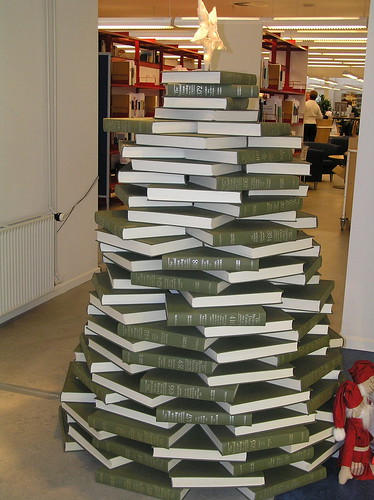
Keep in mind that this was just a picture i took at the locval University Library in Aalborg - www.aub.aau.dk/ - thanks for the nice comments and making this a fave.
Subscribe to:
Posts (Atom)